A ROLL CALL OF ARTISTS ASSOCIATED WITH WOODSTOCK’S PLOWSHARE

Updated: Dec 15, 2025
By Bruce Weber
Current visitors to the new Woodstock library are able to view the exhibition The Art and Artistry of The Plowshare, 1916-1920, which is on display in a glass case on the second floor.
On Saturday morning December 13th from 10:30 a.m. to noon I'll be at the Woodstock School of Art for the final day of In the Open Air: The Art Students League's Woodstock School of Landscape Painting and Its Impact - DON'T MISS IT (open till 3. p.m.) .
At 3:30 p.m. on the 13th, I will be giving a talk at the Woodstock Library on the Plowshare exhibition.
Accompanying the show is the booklet The Plowshare: Artistry and History of Woodstock’s Little Magazine, 1916-1920, which contains my essay on this fascinating periodical, whose pages provide an extraordinary window into the history, culture and development of Woodstock, especially the art colony.
The booklet is for sale at the library for $15, and includes illustrations of some of the outstanding prints that appeared there.
The library has nearly a complete run of The Plowshare. Most issues are available to view on Google Books.
For December 1916-November 1917: https://books.google.com/books/about/The_Plowshare.html?id=bsiag7OSEuUC.
For December 1917-December 1918:
The issues from January-November 1919 are not currently available on Google Books, but they are expected to be viewable in the near future.
For December 1919-November 1920: https://www.google.com/books/edition/_/a1emLKXIdnYC?hl=en&gbpv=1.
This month’s post features a selection of prints by artists whose work appeared inThe Plowshare alongside brief biographies. The booklet includes an appendix which features a listing of the artists accompanied by the dates when their prints appeared
THIS PIECE IS DEDICATED TO THE MEMORY OF DOUG JAMES.

John Everts Bates (1891-?)
Untitled, 1918
Woodcut
The Plowshare, February 1918
John Everett Bates was a native of Island Falls, Maine, and died in Windham, Maine. He attended Yale University, and was active in Woodstock by 1915. In July 1919 he had a joint exhibition with Henry Mattson at the Maverick Concert Hall that included portraits and at least one caricature. Bates studied in Woodstock with Henry Lee McFee and exhibited at the Woodstock Artists Association in the course of the 1920s.

Clarence Bolton (1893-1962)
Untitled, 1919
Woodcut
The Plowshare, March 1919
Over the course of a career in Woodstock spanning nearly five decades, Clarence Bolton produced a remarkable body of work. Bolton was active as an easel and sign painter, draftsman, textile and graphic designer, and maker of lithographs, woodcuts, linocuts, and occasional watercolors. In around 1929 he opened a commercial printing business in town, which was known by a variety of names, including Bolt’s Press, Bolt’s Print Shop, The Bolton Press, and The Woodstock Print Shop. The shop produced announcements, business, greeting and holiday cards, tickets for events, programs, account sheets, brochures, notices, invites, stationery and ads, all featuring Bolton’s graphic design.
Bolton appears to have initially developed an interest in printmaking in 1919 when he contributed a woodcut of a sailboat to The Plowshare. In 1930 he initiated his own monthly periodical The Clatter, which appears to have ceased publication in around July of the following year, and initially was spurred on by the interest and enthusiasm of townspeople and his friends. The Clatter was extensively illustrated with Bolton’s woodcuts and linocuts, and was dominated by images of landscapes of mountains, streams, rocks or trees, which celebrate Woodstock’s beauty in every season of the year. His writing in The Clatter was comical in spirit, and featured brief articles on a variety of topics, including art, notices of local events and exhibitions, creative pages for children, and the seasons, as well as short stories (often about country life), and poetry.

Leslie Griffen Cauldwell (1861-1941)
The Plowshare (Cover), April 1919
Leslie Griffen Cauldwell was active as a portrait, landscape, figure painter, decorator and teacher. He executed a series of portraits in pastel during the course of World War I, including aviators, hospital workers and officers of various armed services, and of varying rank. Cauldwell later became known for his likenesses of actors in costume and was prominent in the American art colony in Paris.

Charles Bayley Cook (1882-1932)
Untitled, 1917
Drawing for a woodblock
The Plowshare, November 1917
Charles Bayley Cook grew up in Portland, Maine, and attended Bowdoin College. By 1909, he was studying with Birge Harrison at the Woodstock School of Landscape Painting. In the mid-teens his interest lessened in rendering subtle atmospheric effects and his art came under the stylistic sway of Impressionism. By 1918, Cook’s landscapes featured a brilliant palette, which led one critic to refer to him as an ultra-modern.(1) Hervey White recalled that Cook managed to keep his feet in both the conservative and modern artistic camps in Woodstock.(2) Later in life Cook was active in England and his native Maine.

Konrad Cramer (1888-1963)
Untitled, 1919
Linocut
The Plowshare, March 1919
Throughout his life Konrad Cramer was open to working in new techniques, styles and media. Restlessly creative he worked with a wide variety of materials, and in addition to painting produced photographs, textiles, batiks, and screens (which he designed and made in the mid-1920s with Robert Winthrop Chanler), and even created modern letters for a new alphabet of his own invention. Cramer was also active as a printmaker, among other things creating linocuts, monotypes, and lithographs. His interest in printmaking deepened after he studied lithography with Bolton Boit Brown in about 1920 in a class that met at Henry Lee McFee’s studio.
According to artist, writer, historian and herbalist Anita M. Smith, Cramer’s arrival in Woodstock in 1912 from his native Germany affected the congeniality of the artists in the village due to the close relationship that he formed with Andrew Dasburg. Cramer became part of the group of fledging modernists in the village who formed a gallery of their work in the dining room of the house of Rose Magee at the cross road of Rock City Road and the Glasco Turnpike, whose motto was “Modern Art or Die!”(3)
In 1919, Cramer followed Dasburg’s lead in exploring the figure in an outdoor setting. He attended Dasburg’s outdoor figure class at the Art Students League in Woodstock that summer. His growing interest in the figure around this time inspired him to picture a man axing down a tree in the forest for his cover of The Plowshare. The man, trees, and fence are silhouetted against a background composed of radiant bursts of the setting sun.

Hunt Diederich (1884-1953)
The Plowshare (Cover), January 1919
Linocut

Hunt Diederich (1884-1963)
The Plowshare (Cover), February 1919
Linocut

Hunt Diederich (1884-1953)
Untitled, 1919
Linocut
The Plowshare, May-June 1919

Mary de Anders Diederich (?-?)
The Plowshare (Cover), July 1919
Linocut
Wilhelm Hunt Dietrich (known as Hunt) achieved renown as an exponent of decorative wrought-iron sculpture. Paris was Diederich’s base from 1908 to 1914. He had an artistic breakthrough in 1913 when, as Diederich scholar Carol Irish Brakebill has noted, he began to “depart from Academic conventions of aesthetic beauty in order to concentrate on expressing his own inner feelings through his work.”(4) Artistic success followed upon the exhibition of his Greyhounds (Crystal Bridges Museum of America Art) at the autumn salon of 1913. Diederich left Europe at the outbreak of World War I. He settled in New York, where he established his reputation as a decorative artist and sculptor, and soon became renowned for figurative pieces created in wrought iron with the technical assistance of blacksmiths. He portrayed hounds, stags, horses, riders, fighting cocks, bulls, and toreadors—often in the thick of combat.
Diederich started spending time in the Woodstock area in the summer of 1917
when he and his artist wife Mary de Anders Diederich rented the farmhouse located directly across from the road that leads to the Maverick Concert Hall. The Dieterichs, Ilonka Karasz and Paul Rohland were the first visual artists to summer in West Hurley. Among the artist’s closest associates in Woodstock were Rohland, Grace Mott Johnson, and Konrad Cramer, all of whom published prints in The Plowshare.
Hervey White recalled that upon showing Diederich the Maverick farmhouse he “Introduced me to his good-natured Russian wife and baby girl [and] they had dinner with me. ‘I like your way of cooking,’ said Hunt. ‘Suppose we eat with you always.’ ‘Yes, yes,’ [Mary] chimed in, her eyes shining, ‘that would be very interesting, very interesting.’ There was no disappointment when I explained that I was too busy printing the Plowshare. They were very interested too, for both immediately offered to make linoleum cuts for illustrations, asking if I had any linoleum, and when I produced it Hunt began sharpening his knife.”(5)
Little is known of Mary de Anders Diederich’s life and career as an artist. In about 1912, Hunt was introduced to her in Paris by the sculptor Alexander Archipenko. She maintained a long friendship with Agnes Schleicher of Woodstock, who as a young girl in 1921 was the subject of a group of portraits painted in Woodstock by Robert Henri. The Diederichs divorced in 1922. Hunt and Mary created linocuts for The Plowshare, including a stunning image by Hunt of a horse and rider for the cover of the issue of January 1919.

Herman Lui Drucklieb (1888-1932)
Untitled, 1917
Linocut
The Plowshare, December 1917
Herman Lui Drucklieb was one of the most prolific and popular American illustrators of the 1920s and early 1930s. He was born in Jersey City, New Jersey, and grew up close by in Montclair. After spending a period of his youth studying in St. Gall, Switzerland, he returned to the United States and attended Pratt Institute in Brooklyn, New York (where he received a Certificate in Drawing in 1908) and the Art Students League of New York. In 1917, Drucklieb settled with his family in Woodstock where he worked as a magazine illustrator and developed his mastery of pen and ink.
Drucklieb’s illustrations appeared in various national magazines, especially Judge (for which he worked for many years beginning in 1912), and John Martin’s Book (from 1913-1932), which was geared to children from five to eight years of age. He also published illustrations under the pen name Lui Trugo. Drucklieb’s obituary in the Kingston Daily Freeman in 1932 mourned that his “death removes another of the famous figures of the Woodstock art colony.”(6)

Emil Ganso (1895-1941)
Untitled, 1920
Linocut
The Plowshare, August-September 1920
Emil Ganso was born in the Harz Mountains of Germany. While he was in his teens he traveled to Bremen and found a job as a dishwasher on the S.S. Crown Prince. Following a number of transatlantic voyages, he jumped ship in 1912 in Hoboken, New Jersey. After taking jobs at bakers in various states he settled in the following year in New York City, where he attended the National Academy of Design. In 1916, Ganso moved to Union Square and for a period shared a studio with Jan Matulka, a fellow student at the Academy, who may have spurred his interest in depicting the nude.
In 1920, Ganso became active as a printmaker. He attended Eugene Fitsch’s evening etching class at the Art Students League and collaborated with an engineer on the construction of the first inexpensive etching press created in the United States. Ganso probably paid a visit to Woodstock that same year, when he contributed linocuts of landscapes and nudes to The Plowshare.
In 1927, Ganso bought a house in town, and came every summer till 1939. He taught private classes at his home in graphic art, including lithography, wood engraving
and intaglio. The artist worked in an extraordinary range of print media, creating linocuts, lithographs, etchings, drypoints, woodcuts, and pochoirs. He also created relief, planographic, and stencil prints.

Ilda Heaton (?-1945)
The Plowshare (Cover), September 1917
Linocut

Ilda Heaton (?-1945)
The Plowshare (Cover), November 1918
Linocut
Little is known about Ilda Heaton, who was born in Switzerland, and was residing in Woodstock by 1917. In about 1920 she settled in New York City where she worked as an illustrator for The Liberator. In 1940, Heaton was confined to a mental hospital in Rockland County.

Neil Ives (1890-1946)
Untitled, 1917
Woodcut
The Plowshare, December 1917
Neil Ives was the son of Halsey C. Ives, who founded the Washington University School of Fine Arts and the St. Louis Art Museum (for which he served as the first director). Before coming to Woodstock Ives studied at the Worcester Polytechnic Institute, the Pennsylvania Academy of the Fine Arts, and the Art Students League of New York. Ives travelled to Woodstock in 1913 to study with John F. Carlson at the Art Students League's Woodstock School of Landscape Painting and remained in town for the rest of his life. In around 1920 he became interested in printmaking, experimenting with woodcut and lithography, the latter developing out of his friendship with Andrew Dasburg, who was exploring the medium at this time.

Grace Mott Johnson (1882-1967)
Untitled, 1917
Linocut
The Plowshare, October 1917 (frontispiece)
Grace Mott Johnson is best remembered today for her sculpture of animals and marriage to the artist Andrew Dasburg. She was born in New York City, and as a child became enthralled by animals, modelling and carving animal figures in soap and with a jack knife. During the summers of 1907 and 1908, she studied with Birge Harrison at the Woodstock School of Landscape Painting. She became romantically involved with her fellow student Dasburg, and the couple married in 1909. Soon after she abandoned the idea of becoming an animal painter and turned exclusively to sculpture. In her art, Johnson sought above all to make her subjects come alive. She aimed to instill her pieces with the same spirit of excitement and interest with which they were initiated.

Charlotte Kennedy (?-?)
Untitled, 1918
Linocut
The Plowshare, October 1918
Charlotte Kennedy grew up in New York City. Her mother Helen McCormack Kennedy was also an artist. Charlotte studied with Douglas Volk, Kenyon Cox and George Bridgeman at the Art Students League of New York, and with John F. Carlson at the League’s summer school in Woodstock.

Blanche Lazell (1878-1956)
Untitled, 1917
Woodcut
The Plowshare, December 1917

Blanche Lazell (1878-1956)
Untitled, 1918
Woodcut
The Plowshare, November 1918
In 1917, Blanche Lazell and her Provincetown colleague Ada Gilmore spent the summer in Woodstock. During the course of this period Lazell studied color theory under the aegis of Charles Emile Schumacher at the Byrdcliffe Arts and Craft Colony, and attended Andrew Dasburg’s private class in Woodstock devoted to outdoor landscape painting and drawing from the figure.
In Woodstock, Lazell experimented with woodcuts, and created several landscape prints. She contributed woodcuts to The Plowshare issues of December 1917, and August and November 1918. During this period Lazell’s prints are usually dominated by strongly curved lines, flat planes, and hard-edged geometry.

Fernand Leger (1881-1955)
Untitled, 1918
The Plowshare, May-June 1919

Fernand Leger (1881-1955)
The Plowshare (Cover), December 1919
Linocut
The May-June 1919 issue of The Plowshare featured the poet and writer Blaise Cendrars’ J’ai Tué (“I Have Killed), translated by Harold Ward, and accompanied by five designs by Fernand Leger printed in black and white. Cendrars garnered his first recognition in English following the publication in The Plowshare of this powerful prose piece describing his hand-to-hand combat to the death with an enemy soldier in World War I. The magazine pronounced that the writer “has for several years occupied a prominent place among the younger generation of French writers, and whose utter simplicity of style is only equaled by the onward rush to his climax.”(7)
At the outset of World War I, Cendrars enlisted in the French Foreign Legion, where he lost an arm in the Battle of the Marnes. In 1918, he collaborated on the creation of J’ai Tué with his friend Leger, who was convalescing from the effects of a mustard gas attack in the trenches of the Argonne Forest. This is one of several collaborations Cendrars and Leger did together. Published just three days before the armistice, the first edition of this stunning illustrated book features double page spreads with color lithographs by Leger.
In the work Cendrars incorporated modern subject matter, including references to trains, radios, machines, advertising, headlines and pop culture, and employed found, cubist, and collage techniques which led him to break with all rules of regular line length, beat or rhyme. The first edition of
the text was printed in red ink, dispensed with paragraph breaks, utilized experimental typography, and incorporated everything from a single-word sentence to huge sprawling lists.
In keeping with the principal of montage that characterizes the structure of Cendrars’ text, Leger originally presented red and blue colored images consisting of a series of jagged cubist gears and cylinders in juxtaposed points of view. The artist followed up his publication in the May-June 1919 issue of The Plowshare with a Cubist cover design utilizing the magazine’s name that was used later in the year for both the November and December issues - published in red ink in November and blue ink in December.

Tod Lindenmuth (1885-1976)
Untitled, 1920
Linocut
The Plowshare, October 1920 (frontispiece)
Tod Lindenmuth’s prints were featured in The Plowshare issues of September-October 1918, as well as June and October 1920. The artist studied in Provincetown with E. Ambrose Webster and George Elmer Browne. He was one of the original Provincetown Printers and a founder of
the Provincetown Art Association. A painter and graphic artist who promoted modernist styles, Lindenmuth began exhibiting woodcuts in 1915 at the Provincetown Art Association. In 1940, he turned away from graphic art to focus on landscape painting, and that year moved from Provincetown to Rockport, Massachusetts.

Carl Eric Lindin (1869-1942)
The Plowshare (Cover), June 1918

Carl Eric Lindin (1869-1942)
The Plowshare (Cover), May 1920
Woodcut

Carl Eric Lindin (1869-1942)
Untitled, 1918
Linocut from a drawing
The Plowshare, July 1918

Carl Eric Lindin (1869-1942)
The Plowshare (Cover), August 1918
Linocut

Carl Eric Lindin (1869-1942)
The Plowshare (Cover), October 1918
The artist, writer, civic activist, designer, and realtor Carl Eric Lindin was co-editor of The Wild Hawk and its successor The Plowshare. He contributed prints and writings to both magazines, and reviews, philosophic essays, poetry, stories, translations and social parables to The Plowshare. Born in Fellingsboro, Sweden, Lindin was employed as a farm, mill and foundry worker during his early years, and emigrated to America in 1887 at the age of 18. Originally he planned to settle in New York City but two Swedes he met on the voyage to America encouraged him to go to Chicago, where he attended evening classes at the Chicago Art Institute and found a job as the assistant to a Swedish interior decorator.
During the early 1890s, Lindin painted trompe l’oeil still life’s of currency, and scenes of everyday life. His work caught the attention of a local businessman who sponsored his study in Paris from 1893-1896. Lindin studied with Jean Paul Laurens, Benjamin Constant, and Aman-Jean at the Academie Julian. During his time off from the academy he traveled to Sweden, where he painted landscapes, portraits and figure studies in oil and watercolor. Over the course of Lindin’s career he regularly returned to his native country to paint.
Upon resettling in Chicago, Lindin became active at Hull House, the pioneering settlement house, and was chosen to decorate its interior. At Hull House Lindin became great friends with Hervey White. They dined together regularly and shared their knowledge and love of literature. Lindin followed White to Woodstock in 1902, where his wife Helen studied book binding and weaving at Byrdcliffe. The Lindins purchased a building that formerly served as a Lutheran church, which was in a pine grove three-quarters of a mile east of the village at the top of a rock ledge. The couple was extremely social, and regularly entertained writers, artists and dancers, including many friends from Hull House.
Lindin became one of Woodstock’s most prominent citizens. Among other things he was a founder of the Woodstock Artist Association (and president of the closely associated Artists Realty Corporation for most of the period from 1920-1940). After Birge Harrison’s death in 1929, he was regarded as the dean of the art colony. In Woodstock, Lindin was primarily active as a landscape painter. He painted landscapes of Woodstock, Sweden, Switzerland, Norway, California, Bermuda, Florida and Massachusetts.
Linden’s early landscapes consist of moonlight and twilight subjects, such as the one he produced later for The Plowshare, one of many landscapes that he created for the magazine, including two radiantly colored covers. In 1904, he had a solo exhibition at the Art Institute of Chicago most of which featured misty landscapes veiled by the pale light of the moon. A critic remarked that Linden “is a poet, a painter of visions, of conceits of things, he possesses a quiet charm all his own. Atmosphere is the dominant trait of all Mr. Linden’s productions. Yet even in his most evanescent effects he pays great regard to space and perspective, structure and form.”(9)
Lindin was an excellent choice as a co-editor for both The Wild Hawk and its offspring The Plowshare. He was a man of serious intellectual interests and had a knowledge of Henrik Ibsen and many other Scandinavian writers. In the art colony his art went through a transformation over the course of the late teens and early 1920. He was especially close to Henry Lee McFee, Andrew Dasburg and Judson Smith, but was equally friends with the more conservative group of artists in town.
During the publication run of The Plowshare Lindin was the perfect middleman between
the diverse forces of artistic interests in Woodstock, and this is reflected in the broad range and style of the prints published there.(10)

Archibald Angus MacKinnon (1891-1918)
The Dutch Reform Church at Woodstock, 1917
From a chalk engraving
The Plowshare, February 1917 (frontispiece)
Artist and illustrator Archibald Angus MacKinnon studied at the Royal Academy of Fine Arts in Antwerp, Belgium (where he won high honors in 1911), and at the Art Students League of New York. He spent time in Woodstock in the mid-teens and may initially have come to the Catskills to study at the Woodstock School of Landscape Painting. During his short life he was best known for his etchings, engravings, and posters and designs he created for advertisements.(11)

Mary Macrae (Mary Macrae White) (?-?)
Untitled, 1918
Woodcut
The Plowshare, August 1918
Little is known of the Scottish-born Mary Macrae. Following her divorce in 1912, she carried on under both the names Mary Macrae and Mary Macrae White and worked primarily as a landscape painter and printmaker. By 1918 she was living and teaching art in Greenwich Village in New York. In 1922 she is known to have spent the summer at Byrdcliffe. Two years later she had an exhibition of her wood block prints at the branch of the New York Public Library on West 115th Street.

Henry Mattson (1887-1971)
Untitled, 1919
Woodcut
The Plowshare, March 1919
Henry Mattson was born in Gothenberg, Sweden in 1887. His father designed and tested locomotives, and was decorated for his efforts by the King of Sweden. He came to the United States in 1906 and studied with his fellow Swede John F. Carlson in Woodstock in the summer of 1916. Mattson quit Carlson’s class and decided to continue working in Woodstock on his own initiative. In time he joined with Carlson and Carl
Eric Lindin to form the core group of Scandinavian-born painters working in the Woodstock art colony.
Mattson achieved national renown. He was represented by the prestigious Rehn Galleries in New York and received a Guggenheim Fellowship in 1935 for creative work in painting. He was active as a landscape, marine, portrait and still life painter. His linocut in the March 1919 issue of The Plowshare is one of his rare prints. As here, elements in his works sometimes are represented at odd angles, possibly under the influence of the skewed perspective of Cézanne.
Woodstock artist and writer Jean Paul Slusser (who also contributed to The Plowshare) wrote that there was “something about [Mattson] of the traditional northern dreamer, something of the rapt solitary [person], of the spinner of folk-yarns, of the merry participant in folk occasion, and the shrewd and humorous teller of countryside anecdote.”(12)

Katherine Maxey Patton (1888-1964)
Untitled, 1918
Woodcut
The Plowshare, January 1918
Katherine Maxey Patton grew up in Wheaton, Illinois. She attended the Art Institute of Chicago (by 1907) and the Art Students League of Chicago (where she served as vice president). In 1913 Patton traveled to Madrid and spent a year studying in Spain, part of the time with Joaquin Sorolla. Upon returning to Illinois, she worked as an artist, interior decorator, and designer of wallpaper murals, and married Alfred R. Patton. Her decorative work reflects the influence of Leon Bakst. In the 1940s, the artist moved to Pasedena, California.

Georg Pauli (1855-1935)
Untitled, 1918
Reproduction of detail in decoration
The Plowshare, June 1918
George Pauli was a Swedish portrait and figure painter, and an art critic and writer. He was celebrated for his socially conscious works, and also experimented with modern styles. He studied at the Royal Swedish Academy of Art in Stockholm, and at the Academie Julian in Paris. In 1887 he married the painter Hanna Hirsch, and they settled in 1905 in Nacka. During the course of his career Pauli created numerous decorative paintings and murals for prominent public buildings in Sweden. In 1911 he studied in Paris with Andre Lhote and for a period moved toward a Cubist style. Pauli was a member of the Opponenterna, a group of artists who opposed the teaching methods of the Royal Academy. From 1917-1921, Pauli was the editor of the art journal Flamman, where he wrote frequently about the new streams of art in Europe.

Ethel Poyntell Peets (1877-1968)
Untitled, 1917
Linocut
The Plowshare, March 1917

Orville Peets (1884-1968)
The Plowshare (Cover), December 1916
The painter and printmaker Ethel Poyntell Peets was a native of Wilmington, Delaware. She started her art training there at the Clawson S. Hammitt School of Art and visited the Byrdcliffe art colony soon after its founding in 1902. Canby bought a house in Woodstock in 1908, and four years later traveled to Paris where she studied at the Academie Moderne and met her future husband, the artist Orville Houghton Peets, with whom she studied etching. After attending the Ecole des Beaux-Arts, Orville was inspired by the engravings of William Blake to explore printmaking, and experimented with etching, wood engraving, woodcuts, and linoleum block prints.
The Peets returned to America shortly after the outbreak of World War I and settled in Woodstock. The art critic F. Gardner Cough reported in the Kingston Daily Freeman that Peets had “perfected a color process that astonishes other artists.”(13). The artist likely shared his knowledge of color printing with Hervey White and other artists involved with the production of The Plowshare. Peets created the cover of the first issue of The Plowshare, which pictures Pegasus carrying a rake and being roped in by Poseidon.
Following America’s entrance into the war, Peets served in the United States Army, where he was involved in military intelligence. From 1919 to 1923 he was commissioned by the Hispanic Society of America in New York to create paintings and etchings displaying the culture and beauty of Spain and Portugal. Ethel remained in Woodstock, and Orville joined her after completing the commission.
Following a period of living in Indian River Hundred in Delaware, the Peets’ returned to Woodstock in 1930. In the late 1930s they settled for the rest of their lives in Herring Creek, Delaware. Orville accepted a teaching position at the newly formed Wilmington Academy of Art and organized the Wilmington Print Club.

Man Ray (1890-1976)
Untitled, 1920
The Plowshare, March 1920
The March 1920 issue of The Plowshare features a cover by Man Ray of his mixed media drawing Silhouette (1916, Guggenheim Collection, Venice). The artist was probably drawn to The Plowshare by his acquaintanceship with editor Gustav Hellstrom and his wife Louise. The picture represents the first stage in the conception of his painting The Rope Dancer Accompanies Herself with Her Shadows (1916, Museum of Modern Art), and represents a single dancer seen simultaneously from three different points of view. Each of the figures is outlined by a thick black line and reduced to a flat shape silhouetted against a black oval form that represents a shadow. The mechanical style of the work is indebted to the influence of Marcel Duchamp, with whom Man Ray became friends in the summer of 1915 following the Frenchman’s arrival in New
York City from Paris.

Mary Ellis Robins (1860-1949)
The Moon Elf, 1919
Zinc plate for design from illustration
The Plowshare, February 1919
The Plowshare included short stories and prints by Mary Ellis Robins, author of Moon Stories and Songs Through the Night, which were published by the Maverick Press.

Paul Rohland (1884-1949)
May, 1917
Woodcut
The Plowshare, May 1917 (frontispiece)

Paul Rohland (1884-1949)
Untitled, 1917
Woodcut
The Plowshare, September 1917

Paul Rohland (1884-1949)
The Plowshare (Cover), March 1918
Linocut

Paul Rohland (1884-1949)
Untitled, 1918
Linocut
The Plowshare, May 1918
Paul Herman Rohland was raised in Richmond, Virginia. In 1899 he worked as a photoengraver at the Christopher Engraving Company in the southern city.(14) The following year his family moved to Philadelphia, where he worked as a copper etcher for Beck’s Engraving, and continued developing his technical skills as a printer. From 1902 to 1909, he studied for periods in New York City at the Art Students League (with W. L. Sheppard and Edward Duffner), the New York School of Art and the Lincoln Arcade (with Robert Henri) and in Paris (neither his school nor his instructors are known).
Rohland studied with Birge Harrison at the Woodstock School of Landscape Painting in the summer of 1909. In 1913, three of Rohland’s works were included in the Armory Show, and in a notable group exhibition at the McDowell Club in New York City, which included some of Andrew Dasburg, Konrad Cramer and Henry Lee McFee’s most experimental canvases. Rohland’s acquaintance with these artists likely spurred his interest in coming back to Woodstock. By 1916 he was living on the Maverick, and was included in an exhibition with Dasburg and McFee at the Maverick Concert Hall.(15) In 1919 and 1920, he exhibited at Konrad Cramer’s wife Florence Ballin Cramer’s art gallery in New York City, and married the Woodstock artist Caroline Speare, who had come to Woodstock in 1912 to study with John F. Carlson at the Woodstock School of Landscape Painting.
During the early 1920s, Rohland was active in the fledgling Woodstock Artists Association. He exhibited landscapes and floral pictures and served as a member of the organization’s committee of control. His aesthetic ties were to the association’s modernist circle of artists. He worked in oil and watercolor, and the print mediums of linocut, woodcut and monotype. His floral pictures rank among his most beautiful, spirited and original works.
The Rohlands had a large and impressive garden at their house in Woodstock, and the artist pictured a wide variety of flowers, including tulips, dahlias, chrysanthemums, poppies and zinnias, and favored a palette of rich oranges, yellows, pinks and reds.
Beginning in February 1917, Rohland’s prints appeared frequently in The Plowshare, including on seven covers. They encompass landscapes in various seasons of the year, floral still life’s, flowers growing in nature, decorative motifs, male nudes, workers in the fields, interiors, and mountain and harbor views. The artist took the opportunity to show off the broad range of his interests and created linocuts and woodcuts, but primarily the former. Three of his covers are colorful linocuts. His most stunning image is the floral still life that graces the cover of March 1918. The artist inspects the casual arrangement of brilliant orange and red tulips and clusters of green leaves up close – hovering over them like a bee in quest of the tulips sweet nectar– and renders the heads of the flowers from a multitude of interesting angles and directions.
In the autumn of 1917, Rohland was recruited to assist Archibald Angus Mackinnon, Charles Emile Schumacher and Coulton Waugh in producing block prints for The Plowshare, and aiding in the overall color process. His assistance with printing was noted in the table of contents. In October, White extolled the need “for a colorwork plant,” and noted that the magazine now has “the man to run it in the person of Paul Rohland who has lately taken to calling himself a native.”(16) The first color print in the magazine was created by Rohland and appeared as the frontispiece in the May 1917 issue. The first color cover appeared seven months later and was created by Coulton Waugh.

Edmund Rolfe (1877-1919)
Captured, 1916
Woodcut
The Plowshare, December 1916

Edmund Rolfe (1877-1919)
Advertisement for The Woodstock School of Metal Work, 1917
Woodcut
The Plowshare, March 1917

Edmund Rolfe (1877-1919)
Hervey White at Press, 1917
Woodcut
The Plowshare, Cover for March 1917
Edmund Rolfe was a native of Detroit, Michigan, and studied at the Art Institute of Chicago and the Art Students League of New York. He came to Woodstock in 1905, when he was hired for a year to take Laurin H. Martin’s place as teacher of metalwork at the Byrdcliffe art colony. Rolfe then established his own metalwork shop and school at his home on a wooded acre west of Byrdcliife. Rolfe exhibited landscapes in New York City, and around the country. He died in 1917 from injuries sustained in a car crash.
Rolfe contributed an engraving for the cover of the fourth issue of The Plowshare picturing Hervey White working at the press. For the December 1916 issue he contributed a woodcut picturing the studio that served as Captain Henry Lang Jenkinson and Bruno Zimm’s Woodstock School of Metalwork.
White led the process of producing the magazine on a hand-powered letter press
set up in a corner of his rustic cabin near Woodstock in the Maverick art colony in West Hurley. From the mid-15th through the 19th century letterpress was the common form of printing text for short-run publications. It remained in wide use for books and other uses till the second half of the 20th century when offset printing supplanted its role in printing books and newspapers. For around a century platen presses were the primary type of letterpress.
White utilized the platen press known as the Pilot, which was introduced in 1891 by the Chandler and Price Company. The Pilot was favored by amateur and private pressman alike because of its ability to print, emboss, perforate, number, score, and foil stamp as well as die cut on many types of materials,
as well as the ease with which the press was made ready for operation and produced short runs.

Charles Emile Schumacher (1870-1931)
The Plowshare (Cover), September 1918
Linocut

Charles Emile Schumacher (1870-1931)
The Plowshare (Cover), October 1920
William Emile Schumacher revitalized the painting department at the Byrdcliffe art colony in Woodstock and brought an avant garde spirit to this bastion of the Arts and Crafts movement. Born in Belgium in 1870, Schumacher was the son of a German-born fabric designer. He came to America as an infant and was brought up and educated in Boston. He studied at the Dresden Academy in Germany in 1888, and at the Academie Julian in Paris from 1890-1896. Following the completion of his studies he was active in France as an illustrator, poster designer, and painter of portraits, figurative works, and landscapes.
In the late 1890s and early years of the 20th century, Schumacher came under the influence of Art Nouveau as well as the work of the Nabi painters Edouard Vuilliard and Maurice Denis. Under the latter’s influence the artist would begin to break his compositions into prismatic patterns, employ dot and dash-like strokes, and occasionally emphasize vivid hues of blue and red. It was in around 1913 that Schumacher began to experiment with a Pointillist technique, influenced by the paintings of Post Impressionist Georges Seurat.
Schumacher returned to America in the summer of 1912. During his first year back, he lived at the boarding house of Clara Davidge at 62 Washington Square South in New York City. Davidge was the principal fund raiser for the Armory Show, and the association likely helped lead to Schumacher’s exhibition there, which spurred a new boldness and brightness in
his handling of color.
In 1913, Schumacher lived briefly in Chicago before making his way to Byrdcliffe, where he taught painting in the summers. In 1925, Schumacher purchased land and constructed a house on the Glasco Turnpike, where he lived year-round and continued teaching. Among Schumacher’s students at Byrdliffe were Eva Watson-Schutze and Blanche Lazzell.
Schumacher concentrated mostly on painting whimsical, imaginative and boldly colored and patterned landscapes and still life’s, which are marked by an increasingly abstract handling of form. Their intersecting-colored planes were impacted by his study of the chromatic musical scale. Over the course of the years 1917-1920, Schumacher created five cover designs and one frontispiece for The Plowshare. In September 1918, he had a solo exhibition
at the Maverick Concert Hall.
Schumacher died in Woodstock in 1931. The foreword to the catalog for the memorial exhibition held at the Woodstock Artists Association noted that Schumacher’s art witnessed “a number of interesting phases, in which he never separated color and form, and held to the importance of the unity of each composition, and the significance of the imaginative mind.”(17)

Jean Paul Slusser (1886-1978)
The Plowshare (Cover), October 1919
Linocut

Jean Paul Slusser (1886-1978)
The Plowshare (Cover), September 1920
Linocut

Jean Paul Slusser (1886-1978)
The Plowshare (Cover), November 1920
Linocut
Jean Paul Slusser was a painter, designer, and art critic, and served as a professor, and museum director.(18) Born in Wauseon, Ohio, he attended the University of Michigan where he received a Masters of Art degree in 1911, and the School of the Boston Museum of Fine Art from 1913-1915, where he studied with Philip Leslie Hale. Slusser spent the summers of 1914-1917 studying at the Woodstock School of Landscape Painting with John F. Carlson. While in town he resided in a boarding house behind the Post Office (located near the town green) where his fellow students included Richard Lahey and Hester Miller.
In 1916, Slusser taught with his Woodstock colleague Hermon More at the Lake Geneva School of Landscape Painting and had a joint exhibition with More at the town’s Guild Hall. Slusser exhibited landscapes of marshes, forest interiors and snowy fields.(19) Early in his career Slusser was mostly known for his figure studies of male nudes in an outdoor setting, several of this subject appeared in The Plowshare. His prints were influenced by German Expressionism and have a strong graphic quality.
Slusser frequented Woodstock until at least the mid-1920s. He worked as an art writer and critic for numerous publications, including the New York Call, New York Herald, Boston Herald, and the magazines International Studio, Art News, and The Arts (where he published articles on Henry Mattson and Paul Rohland in 1928). For a period in the 1920s he served as an assistant to Henry McBride at the New York Sun. From 1924-1925, he studied at the Hans Hoffman School in Munich, Germany.
Slusser taught in the art department at the University of Michigan for 36 years and was the first director of the University of Michigan Museum. He donated works to the museum by fellow Woodstockers Ilonka Karasz and Alfred Hutty. He also donated an early barn scene that he painted in Woodstock. His family gave the institution his linocut Under the Olive Trees. Slusser made a return visit to the area in the summer of 1950 to attend the third annual Woodstock Art Conference.

Zulma Steele (1881-1979)
Untitled, 1918
Linocut
The Plowshare, March 1918
[frontispiece – printed wrong side up]
Born in Appleton, Wisconsin, Zulma Steele moved with her family to Rutland, Vermont at the age of 8. The artist’s mother Zulma DeLacey Steele was active as a landscape painter, and her brother Frederick Dorr Steele was a professional illustrator. In the mid-1890s she studied at the Art Institute of Chicago and the Boston Museum School, and from 1899-1903 she studied with Arthur Wesley Dow at Pratt Institute in Brooklyn.
In 1904, Steele became one of the first artists to receive a scholarship to study at Byrdcliffe. During her initial two years there she designed furniture on her own as well as in collaboration with Edna Walker after work produced in the studio of William Morris. She also studied landscape painting at Byrdcliffe with Birge Harrison. Her earliest landscapes reflect the strong influence of Harrison, but by 1914 she adopted a more modern and individual approach, and soon was creating landscapes featuring bold, pure colors, simplified shapes and strong rhythmic patterning.
In around 1915, Steele executed her Ashokan Dam series, which was inspired by the dramatic transformation of the landscape south and west of West Hurley. At round this time Steele created a group of monotypes, including picturing the front of White Pines, the Byrdclffe founder Ralph Radcliffe Whitehead’s residence at Byrdcliffe. The artist was producing monotypes by 1914, when she exhibited prints of Italian and Irish subjects at the annual exhibition of the Cincinnati Art Museum.
In 1916, Steele supplied prints to The Plowshare. Her most avant garde effort as a printmaker is the abstract linocut she created for the March 1918 issue, which features rhythmic curvilinear forms that recall some of Konrad Cramer’s abstract compositions of a few years before.
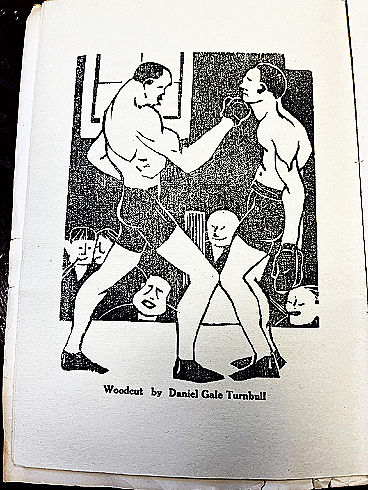
Daniel Gale Turnbull, Jr. (1886-1964)
Untitled, 1920
Woodcut
The Plowshare, January 1920
David Gale Turnbull, Jr. was born in Long Island, New York. He attended Pratt Institute and City College in New York City and moved to France in 1912 where he studied art in Point Croix with Vojtech Preissig and Charles Lassar. Following American field service in World War I he painted around France, especially in Paris, Provence and Normandy, and was involved with the formation of the Group of American Painters. Turnbull returned to the U.S. in 1927, and was appointed art director of Leigh Potters (Alliance, Ohio) in 1929, and art director of Sebring Pottery (Sebring, Ohio) in 1931. By this time Turnbull was working in a Cubist style, employing geometric shapes and solid colors. In 1936, Turnbull was hired by Vernon Kilns and settled in California.

Coulton Waugh (1896-1973)
The Plowshare (Cover), December 1917
Linocut
Coulton Waugh contributed linocuts for the covers of the issues of June and December 1917, and a woodcut for the issue of January 1919. Waugh emigrated to the United States from England in 1907 and settled in Philadelphia with his father, the marine painter Frederick J. Waugh, who was his first teacher. Waugh attended the Art Students League in New York where his teachers included George Bridgeman, and Frank Vincent Dumond. In 1913 he studied with John F. Carlson at the League’s Woodstock School of Landscape Painting and began a period of sporadic activity in the Woodstock art community. Over the course of his time in the Catskills he painted landscapes and still life’s.
In the late teens Waugh designed textiles and advertisements for the textile industry. By the early 1920s he shifted to newspaper work and began creating color spreads for the Sunday Section of the New York World (some of which include his pioneering pictorial maps). The artist frequented the art colony on a regular basis until 1921 when he moved to Provincetown following his marriage to Elizabeth Jenkinson, daughter of the Woodstock metalsmith and teacher of metalworking Captain Henry Lang Jenkinson. In Massachusetts the couple operated a model ship and hooked rug shop.
Waugh later became well known for his comic strip Dickie Dare, and authored the book The Comics, the first comprehensive study analyzing comic strips and detailing their history, and wrote instructional and educational art books (two on painting with palette knives). In the 1940s, Waugh moved to Newburgh, New York, where he taught at Orange County Community College, and served as the curator of the Storm King Art Center in Mountainville.

Bruno Zimm (1876-1943)
The Plowshare (Cover), July 1917
Linocut
Bruno Zimm was born in Hoboken, New Jersey in 1876. His talent as a sculptor was evident at a young age. At 15 he was introduced to Karl Bitter, who taught him privately and later employed him as an assistant in his studio. In 1893 he supervised the installation of Bitter’s sculpture at the Worlds Columbian Exposition in Chicago. In addition to receiving instruction from Bitter, Zimm studied at the Art Students League of New York from 1891-1892 and again from 1896-1897, where his teachers included John Quincy Adams Ward and Augustus St. Gaudens. He also spent time in Paris in about 1900.
Following in the footsteps of his mentor Bitter, Zimm worked mostly as an architectural sculptor in the Beaux-Arts tradition. Over the course of his career, he also created portraits, medals, carved mantle pieces, and other wood panels for domestic interiors, and melted small quantities of brass or bronze to make casts of small objects such as paper knives.
In about 1910, Zimm and his first wife Roddie settled in Woodstock. They purchased an abandoned farm consisting of 79 acres on the outskirts of the village in Lewis Hollow (now upper Lewis Hollow Road), Zimm constructed and decorated the property with sculpture, including carvings in wood and stone, and transformed it into one of Woodstock’s most magnificent artist houses. By 1919, Zimm had divorced his first wife, and married Louise Seymour Hasbrouck, one of the founders of the Historical Society of Woodstock, and a genealogist, specializing in Ulster County families.
In 1916, Zimm joined the Woodstock School of Metal Work, a notice for this short-lived school appears in the December 1916 issue of the The Plowshare along with a wood cut by Edmund Rolfe of the studio where classes were held. Zimm created a striking cover design in black and white of a man’s head in profile for the issue of July 1917. It is Zimm’s only known print.
Footnotes
(1) “Spring Exhibit of Portland’s Society of Art,” Lewiston Sun-Journal, May 8, 1915, Illustrated Magazine Section, p. 29.
(2) White, “Autobiography,” p. 192.
(3) "Konrad Cramer," The Overlook 2 (June 25, 1932): 7.
(4) Carol Anderson Irish Brakebill,” William Hunt Diederich: Negotiating the Path from Sculpture to Decorative Arts,” M. A. Thesis, Bard Graduate Center for Studies in the Decorative Arts, Design and Culture, 1999, p. 109.
(5) White, “Autobiography,” p. 236.
(6) “Local Death Record.” Kingston Daily Freeman, May 11, 1932, p. 6.
(7)” Editorial,” The Plowshare 8 (May-June 1919): n.p.
(8) Henry Miller, “Preface,” Selected Writings of Blaise Cendrars (New York: New Directions, 1966), p. viii.
(9) "Carl Olaf Lindin's Fine Paintings: An Interesting Exhibition at the Art Museum," otherwise unidentified newspaper clipping, Carl Eric Lindin files, Woodstock Artists Association Archives.
(10) For a discussion of the problems that ensued in the early 1920s at the Woodstock Artists Association between artists of conservative and modern interests see the author’s article “In Quest of Harmony: The Founding and Early Years of the Woodstock Artists Association” Hudson Valley Review, vol. 36, no. 1 (Autumn 2019): 34-54.
(11) “Archibald Angus MacKinnon,” American Art News 17 (November 9, 1918): 4.
(12) Jean Paul Slusser, “Henry Mattson,” The Arts 20 (January 1920): 27.
(13) F. Gardiner Clough, “Orville H. Peets Has Fine Exhibition,” Kingston Daily Freeman, August 28, 1929, p. 14
(14) For additional information on Rohland see Bruce Weber and Melinda Meister, “Paul Rohland (1884-1949): A New View of Woodstock Art Colony Artist “on the website Learning Woodstock Art Colony.
(15) “Art Exhibit at the Maverick,” Kingston Daily Freeman, July 28, 1916, p. 12.
(16) “Editorial Impressions,” The Plowshare 6 (October 1917): n.p. Artists initially were resistant to having their cover designs printed in color. “Editorial Confidences,” The Plowshare 6 (January 1917): n.p.
(17) The remark in the foreword of the Woodstock Artists Association’ memorial catalog is quoted in a short biography of Schumacher prepared by Hollis Taggart Galleries. The author has yet to personally view this publication. A copy is not found in the Woodstock Artists Association archives.
(18) For biographical information about Jean Paul Slusser see
(19) “The Paintings at Guild Hall,” The Lake Geneva News, August 17, 1916, p. 1.

Outdoor projects often work best when drainage, materials, and long-term maintenance are considered from the beginning. Hardscaping Services in Seattle, WA can provide useful options for creating attractive paths, patios, and structural features while keeping the overall landscape practical for local conditions.
Different rugs can require different cleaning and maintenance approaches, which makes professional treatment valuable. I found the discussion helpful because using unsuitable products or methods can sometimes cause unwanted results. Anyone searching for Rug Treatments services near me may appreciate professional guidance based on the rug's material, construction, age, and current condition.
Destination weddings require much more planning than a normal vacation, particularly when guests are traveling from different locations. Coordinating flights, hotels, transportation, and schedules can quickly become overwhelming. The information here shows why professional assistance can be valuable. Couples searching for a destination wedding travel agency in Columbus GA can benefit from having someone help organize the travel details for everyone involved.
Regular maintenance is often overlooked until a roofing problem becomes obvious. The information here makes a good point about addressing damage before it develops into a larger concern. For local property owners considering commercial metal roof repair Tama, IA, understanding early warning signs can help with better maintenance planning.
I enjoyed reading this guide because it focuses on practical solutions for motorists. A reliable Tow Truck Milford CT can help move vehicles that cannot continue safely, reducing stress during roadside situations.