Lachaise and the Historic Woodstock Art Colony - Part 2
By Virginia Budny
November 6, 2026
(Part I appeared on
September 4, 2026)
Just a reminder that the Rosella Hartman exhibition closes on Sunday November 8th at the Historical Society of Woodstock, which recently celebrated the opening of its Jean E. White Archive Buillding. The Avery Family exhibition closed at the Kleinert-James on October 25th. This exhibition will be touring to the Albany Institute of History and Art for an opening early in the new year.
Hart Crane’s “Interludium”
On January 9, 1924, seven days after returning to New York City from Woodstock, Hart Cane sent a letter to Lachaise and Isabel along with the first version of “Interludium.” As he explained, they had inspired the idea for his new poem.

Hart Crane, Letter to Mme and Gaston [Lachaise], New York, N.Y., January 9, 1924, Gaston Lachaise Collection, YCAL MSS 435, Series 1. General Correspondence, 1906–1957, Box 1, Crane, Hart and Grace Hart, Yale Collection of American Literature, Beinecke Rare Book & Manuscript Library.

Hart Crane, “Interludium” [first version], ca. November–December 1923.
Gaston Lachaise Collection.
The letter reads in part:
"There are no memories stronger than the spiritual outlines of rock and branch so bare and fine as winter mountains yielded me while I was with you and two precious others recently. So, in a moment of enthusiasm for all things great I must inscribe a greeting and regret (thus floridly!) that we can't presently walk and talk ‘all together.’ And, as a sort of apology, offer the enclosed poem to your appreciation or extenuation of such in relation to at least one other admiration of yours—reflection to my better moods. Especially do I send it—because I feel it had its first thought in the dance of music, flesh and stone wherein you live always—you two!"
The poem:
INTERLUDIUM
Thy time is thee to wend
with languor such as gains
immensity in gathered grace; the arms
to spread; the hands to yield their shells
and fostering
thyself, bestow to thee
illimitable and unresigned
(no instinct flattering vainly now)
thyself that heavens climb to measure
thus unfurling thee untried,—until
from sleep forbidden now
and wide partitions in thee—goes
communicant and speeding new
the cup again wide from thy throat to spend
those streams and slopes untenanted thou
hast known ….. And blithe
Madonna, natal to thy yielding
still subsist I, wondrous as
from thy apart dugs shall still the sun
again round one more fairest day …..
I believe that, in “Interludium,” Crane expresses his exalted response to his stay in mountain-encircled Woodstock while in the company of Lachaise and his wife and “two precious others [Nagle and Brown].” As indicated in his letter, the female subject represents “the spiritual outlines of rock and branch” of a bare winter mountain, like those he praised while he was there.
In the following July, Crane published the last of the three subsequent versions of the poem in the first issue of the short-lived 1924: A Magazine of the Arts (Woodstock, N.Y.), produced by writer Edwin Seaver (1900–1987) and his wife, Vera Bass (1900–1988), inhabitants of Zena, near Woodstock. By then, the poem was dedicated to Lachaise’s “La Montagne [The Mountain],” in other words, to one of the artist’s two modernist stone sculptures of a generous nude, both of which, like the poem, equate a mountain with a woman.(1) Crane thus explicitly identified his poem as an ekphrasis—although he may have already been thinking of one of the statuettes when composing the poem in Woodstock. He possibly added the dedication when publishing it in 1924 to relate it to his ekphrastic “Sunday Morning Apples: To William Sommer” in the same issue, and distance himself somewhat from the contents.

Gaston Lachaise, La Montagne [LF 208], model 1913, carved 1919, Hudson Blue (sandstone), 8 3/8 in. high. Photograph, published in Scofield Thayer, Living Art: Twenty Facsimile Reproductions after Paintings, Drawings and Engravings and Ten Photographs after Sculpture by Contemporary Artists (New York: Dial Publishing Co., 1923), sculpture sec., pl. 9.

Gaston Lachaise, La Montagne [LF 29], directly carved 1923–24, limestone, 9 x 20 x 9 in., signed (near proper left foot) “G LACHAISE.” Memorial Art Gallery, University of Rochester, N.Y., Gift of Dr. Michael L. Watson, 1977.11.

Gaston Lachaise, Chronological list of captions for photograph nos. 75–79, for his (dismantled) 1925 photograph album, typescript, ca. October 1925, autograph annotation in ink, ca. 1928. The Lachaise Foundation.
The earlier stone sculpture was commissioned by the wealthy aesthete Scofield Thayer in 1919 and reproduced as the frontispiece of the March 1921 issue of The Dial, an important magazine co-owned by him and James Sibley Watson Jr. (1894–1982), an extremely affluent young man. Thayer, a member of an intimate circle of friends that included Nagle, and who came to consider Lachaise as America’s greatest sculptor, reproduced views of the front and back of the statuette in his deluxe portfolio, Living Art, which he printed in Berlin in 1923.(2) Lachaise may have begun the second stone statuette in Georgetown for Dr. Watson, another member of the group, soon after proposing the work to him in July 1923 and promising to begin it immediately. Lachaise completed that version in either New York City or Woodstock, or both, as he inscribed “1924” on it, and assigned the same year to it in a letter dated February 6, 1924, thus providing a terminus ante quem for the carving. He confirmed that year in his caption no. 75 for the (lost) photograph of the statuette in his 1925 photograph album.(3)
At the end of Crane’s mystical poem, his account of the subject’s wondrous elevation of the sun evokes a vision of the raising of the host during Mass and a promise of spiritual rebirth.(4) The immediate source of that striking image could have been the awesome sight of the sun arcing above a mountain visible from the Rectors' house, together with the perception of an animating principle analogous to the elemental forces Lachaise aimed to convey in his art. Certainly, Crane’s two-month stay in Woodstock seemed to him at the time to have offered an opportunity to feel temporarily "like a new man—better than I can ever remember feeling”;(5) and "Interludium" appears to commemorate this heightened emotion.
Lachaise in Woodstock, 1924
In the new year, Lachaise continued to go back and forth between Woodstock and New York City. He completed sculptures and created new models in both places, including marketable works for his current dealer, John F. Kraushaar (1871–1946), owner of the C. W. Kraushaar Art Galleries, although where he sculpted in either location is unknown. Some of these works can be situated in Woodstock, as especially evidenced by the following sources: photographs of them taken there by the Stowall Studios, a local company owned and operated by Alfred Albert Cohn (1897–1972), a graduate of the Clarence H. White School of Photography in New York City; copyright registrations listing Woodstock as Lachaise's address; and other contemporary records. These documents show that Lachaise advanced or completed the following artworks in Woodstock between February and June at the latest.

Gaston Lachaise, Portrait Bust of Scofield Thayer, Esq. [LF 149], modeled 1923–24; cast ca. February 1–June 13, 1924, bronze, 12 5/8 in. high, on a stepped-glass base. Photograph, Peter A. Juley & Son, New York, N.Y., 1924. The Lachaise Foundation.
Lachaise evidently began his portrait of Scofield Thayer [LF 149] in New York City by November 23, 1923;(6) took a plaster cast of the model to Woodstock on February 2 to work on it there; developed it further in Manhattan; and then worked on the bronze after it was cast. On June 13, 1924, Thayer sent a letter to Lachaise in Woodstock, thanking him for photographs of his portrait like the one seen here (thus providing a terminus ante quem for the casting date). But a copyright registration dated June 10 for another work by Lachaise lists his address as Georgetown, suggesting that he may have already left Woodstock by then. As part of Thayer’s large bequest, the Metropolitan Museum of Art owns this cast and a slightly revised copy made by Lachaise for Thayer’s mother, in which he revised the lips in response to her criticism of their large size in the original bronze.

Gaston Lachaise, Portrait Statuette of Miss Marjorie Spencer [LF 205], modeled 1924, © 1924, plaster, 16 in. high. Photograph, Peter A. Juley & Son, New York, N.Y., 1924, from Lachaise’s 1925 dismantled photograph album, no. 80. The Lachaise Foundation.

Gaston Lachaise, Portrait Bust of Edward Nagle, Esq. [LF 46], modeled 1924, plaster, ca. 14 in. high. Photograph, probably by 1925. The Lachaise Foundation.
The model for Lachaise’s statuette of Marjorie Spencer [LF 205] represents the vivacious, bobbed-haired nineteen-year-old dressed in a robe de style, a fashion Lachaise especially admired. The copyright registration for a bronze statuette of that work, obtained by Lachaise on May 9, lists his address as Woodstock. The model for the portrait of his stepson [LF 46] was finished by him immediately before April 16, a fact announced by him in a letter written in Woodstock on the same day.

Gaston Lachaise, Turkey [LF 314], modeled 1924, plaster, 39 in. high. Photograph, Stowall Studios, Woodstock, N.Y., from Lachaise’s dismantled 1925 photograph album, no. 83. The Lachaise Foundation.

Photocopy of an installation photograph for “Exhibition of Paintings by Zuloaga and Sorolla, and Sculpture by Lachaise and Bourdelle,” The Cleveland Museum of Art, November 7–December 15, 1924. Turkey [LF 314] is one of four sculptures by Lachaise visible here. The photograph was destroyed by the museum.
The life-size plaster model for Turkey [LF 314], a garden sculpture, represents a splendid Eastern Wild Turkey—a native bird likely seen around Woodstock by Lachaise, an ardent animal lover. It was photographed by the Stowall Studios. The model was exhibited in the 1924 Summer Show of his representative, the C. W. Kraushaar Art Galleries, at 680 Fifth Avenue, between Fifty-third and Fifty-fourth Streets, New York City. Patinated to look like bronze, it was also exhibited, for example, at the Cleveland Museum of Art. Never cast in bronze, the model disappeared sometime between 1928 and about 1938.

Gaston Lachaise, Signs of the Zodiac (top: Aries, signed; bottom: Aquarius, signed), 1924, plaster, models for elevator doors. Photograph, Stowall Studios, Woodstock, N.Y., 1924, from Lachaise’s 1925 dismantled photograph album, no. 85. The Lachaise Foundation. The plaster models no longer exist.

Gaston Lachaise, Aries, cast ca. 1924, bronze, signed, bottom roundel, elevator door at left, entrance lobby, 550 Seventh Avenue, New York, N.Y.

Gaston Lachaise, Aquarius, cast ca. 1924, bronze, signed faintly, center roundel, elevator door at right, entrance lobby, 550 Seventh Avenue, New York, N.Y.
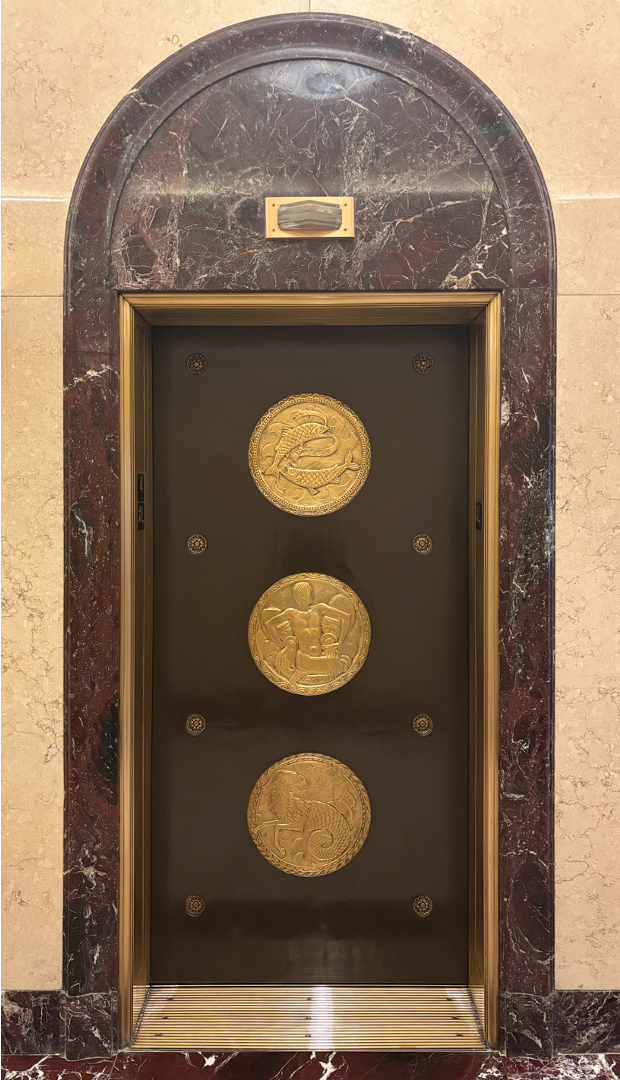
Gaston Lachaise, Signs of the Zodiac (top roundel: Pisces, signed; center roundel: Aquarius, signed faintly; bottom roundel: Capricorn, signed), cast ca. 1924, bronze, elevator door at right, entrance lobby, 550 Seventh Avenue, New York, N.Y.

Gaston Lachaise, Decoration for Bronze Mailbox, for the entrance lobby of 550 Seventh Avenue, New York, N.Y., modeled 1924, plaster. Photograph, Stowall Studios, Woodstock, N.Y. from Lachaise’s dismantled 1925 photograph album, no. 86. The Lachaise Foundation. The plaster model no longer exists.
Lachaise created the models for twelve signs of the Zodiac in roundels for four bronze elevator doors (three to a door), and for the decoration for a bronze mailbox, to embellish the entrance lobby of the new twenty-six-story loft building at 550 Seventh Avenue Building in New York City. Architect Ely Jacques Kahn (1884–1972), who designed the building, had recommended Lachaise for this important commission. Photographs by the Stowall Studios of Lachaise’s plaster models for two of the roundels and the front of the mailbox are owned by the Lachaise Foundation. The bronze doors and mailbox remain in situ.

Gaston Lachaise, Dolphins for a Bronze Fountain [LF 44/LF 319], 1924, pencil, wax crayon, and opaque watercolor on paper, 30 9/16 x 39 3/8 in., Whitney Museum of American Art, Gift of the Renee and Chaim Gross Foundation, 2017.19.
While staying in Woodstock, Lachaise evidently created the models for Dolphin Fountain [LF 44/LF 319], a garden ornament; and Wild Turkey [LF 146], a decorative radiator cap. He made the wooden and plaster model for Dolphin Fountain partly by assembling individual wooden dolphins that he had detached from a smaller model, and he executed an unusually detailed drawing of the new model to illustrate his copyright application for the “design for a work of art.” The official copyright registration, dated April 4, was addressed to him at Woodstock. Two bronze casts of the fountain were made in 1925; one was among his first three sculptures to enter the new Whitney Museum of American Art in 1931, as a gift from Gertrude Vanderbilt Whitney (1875–1942), a sculptor, art patron, and the museum's founder.

Gaston Lachaise, Model for a Radiator Cap (Wild Turkey) [LF 146], modeled 1924, © 1924, plaster, 3 1/2 in. high. Photograph, Stowall Studios, Woodstock, N.Y. The Lachaise Foundation. The model no longer exists.
Lachaise evidently made the model for his small Wild Turkey for a Radiator Cap [LF 146] in Woodstock, as the plaster model mounted on a cap was photographed by the Stowall Studios, even though the record of the copyright, officially registered on June 10, 1924, was addressed to him at Georgetown. Three bronze casts were made from the model, one of which, lacking the cap, was recently sold at auction.
Lachaise’s Portrait of Jeanette Fiene, ca. 1926–27
By June 1924, Lachaise was in Georgetown, and he apparently remained there throughout the summer. By November 14, he was living and working in a new apartment, at 20 West Eighth Street in New York’s Greenwich Village. In August 1925, the Lachaises were moving into their newly renovated house in Georgetown and already entertaining guests, and Lachaise was working in his commodious studio across the street. Thereafter, he divided much of his time between New York City and Georgetown.

Ernest Fiene (1894–1965), Portrait of Isabel Lachaise, signed and dated 1926, oil on canvas, 30 x 25 in. The Lachaise Foundation.

Gaston Lachaise, Head of Jeanette Fiene [LF 164], modeled ca. 1926–27, cast by 1927, © 1927, bronze, with nickel plate and brown patina, 13 5/8 in. high, on a quarry-faced base. Photograph, Peter A. Juley & Son, before March 7, 1927. The Lachaise Foundation.

Gaston Lachaise, Fountain Figure [LF 181], model 1926, carved July 1926–February 1927, © 1927, Tennessee Marble (limestone), with selective tint, 72-in. high. Photograph, Peter A. Juley & Son, taken in The Intimate Gallery, Room 303, Anderson Art Galleries Building, 489 Park Avenue, New York, N.Y., March/April 1927. © Peter A. Juley & Son Collection, Smithsonian American Art Museum.
It is not known if Lachaise ever returned to Woodstock after 1924, despite the inclusion of his nickel-plated bronze portrait of Jeanette [LF 164], Ernest Fiene’s wife, in the Woodstock Art Association’s third summer show in 1927, held from July 23 to August 10.(7) When the head had first been shown to the public, in Lachaise’s exhibition at Alfred Stieglitz’s The Intimate Gallery, scheduled for March 7–April 3, 1927 (but extended for several days), it was on loan from Ernest Fiene, and Fiene evidently lent it to the exhibition in Woodstock, in which his own work also appeared.
Jeanette Fiene reported that she sat for her portrait more than twenty times.(8) I believe that these sessions took place while her husband painted a portrait of Isabel in 1926, and probably while Lachaise worked on his third major commission, a larger-than-life figure in Tennessee Marble for a garden fountain [LF 181], in his Georgetown studio during the second half of 1926, and perhaps also while he completed the statue in New York City in the first months of 1927.(9) The bronze cast of Lachaise’s portrait of Jeanette was mounted on a quarry-faced base, likely for expediency, when it was photographed to illustrate his application for a copyright (which was officially registered on April 30, 1927). It was remounted on a straight-edged black Belgian marble base by the time it was exhibited in the Intimate Gallery show, where it was photographed by Alfred Stieglitz—one of the photographs is owned by the National Gallery of Art, Washington, D.C.
In the summer of 1928, Ernest Fiene exhibited Lachaise’s portrait of Jeanette in a still life painting at the Kraushaar Galleries, which had represented him since 1927.(10) On March 29, 1933, Lachaise borrowed the bronze in order to place it in the window of the Kraushaar Galleries, reporting to Isabel in a letter written to her on that day: “It looks well there.” According to a Lachaise Foundation record, the cast was originally inscribed with the signature and copyright date of 1927, but after the Foundation acquired the sculpture in 1985, it removed the nickel plate, which had been damaged, along with any inscriptions that Lachaise may have ground into the metal.
There are other scattered references to the Ernest Fienes and the Lachaises’ ongoing friendship. For example, in 1928, the Fienes visited the Lachaises in Georgetown, and Fiene thanked them with a lithograph, Snug Harbor, 1928, “in memory of our enjoyable visit.”(11) Fiene evidently offered to send Mountain Laurel to the Lachaises around that same time, as Lachaise wrote to him on November 26, 1928 (shortly before the Fienes went to Paris for almost a year), to accept his offer of a dozen shrubs, which “will be very generous and surely will help to the making of the garden.”(12) The garden was a highly prized feature of the Lachaises’ lovely country home.
Lachaise continued his friendships with the Ernest and Paul Fienes, although evidently not in Woodstock. He also exchanged a sculpture for a painting by the future Woodstock-based artist Yasuo Kuniyoshi (1889–1953), probably in 1925 in New York City, though the Kuniyoshis and Lachaises do not appear to have been close friends.(13)
Lachaise and Woodstock Today

Gaston Lachaise, Head, 1924, red crayon on paper, 14 x 10 in., signed. Woodstock Artists Association & Museum, Gift of Joel Rosenkranz, N.Y., 2019–11–04.

Gaston Lachaise, Woman (Nude), 1929, graphite and ink on paper, 24 x 20 in., inscribed “To Carl Zigrosser/ G. Lachaise/ 1929.” Woodstock Artists Association & Museum, Gift of the Estate of Adrian and Sophie Siegel, 1994-06-29.
Lachaise’s ties to Woodstock are ongoing, as the Woodstock Artists Association owns two of his drawings. Head, like a number of similar drawings, was very possibly made while he was in Woodstock in 1924. Woman was carried out in a style seen only in 1929, and was dedicated by him to the director of the Weyhe Gallery—which, for example, purchased five bronze casts of Woman (Elevation) [LF 55] in 1930, all now owned by museums.(14) That second drawing joyfully exhibits Lachaise’s increasingly uninhibited celebration of what he viewed as healthy sexuality, and both drawings present the vision of “Woman” seen in many of his other ideal works of art.
Virginia Budny is the author of the forthcoming catalogue raisonné sponsored by the Lachaise Foundation. She is thankful for the Foundation’s support for the present study, which contributes to that project.
(1) Previous accounts of Crane’s revisions to the text of his poem do not address the version sent to the Lachaises, and thus are flawed. He gave copies of a second, somewhat revised version to his friend Gorham Munson (1896–1959) evidently after both men had returned to in New York City in early 1924 (sometime after January 9): two typescript copies corrected in typescript and ink are among the Munson papers at Ohio State University (Hart Crane Correspondence to Gorham Munson and George Bryan, Spec.Rare.CMS.0022, Rare Books & Manuscripts Library, Box 3); another, presently unlocated typescript copy similarly corrected in typescript and ink at Ohio is recorded in a photocopy at Columbia University (Hart Crane papers, 1909–1937, Rare Book & Manuscript Library, Columbia University Libraries, Box 19). The third version, in typescript, is in Crane’s three-ring Notebook of poems among the same papers at Columbia (Box 10). In that version, Crane definitively replaced “thy” in the penultimate line with “thine” and included the dedication, perhaps an afterthought, as it is in darker type than the rest of the text and thus appears to be a later addition. A typescript of the fourth, 1924 version (which includes several more revisions) is also among his papers at Columbia (Box 9). The second and fourth versions of the poem are included in Brom Weber, Hart Crane: A Biographical and Critical Study (New York: Bodley Press, 1948), pp. 393–94. The third version was published in The Complete Poems and Selected Prose of Hart Crane, ed. and with an introd. and notes by Brom Weber (London, Liveright Pub. Corp. 1966), p. 152.
(2) Scofield Thayer, Living Art: Twenty Facsimile Reproductions after Paintings, Drawings and Engravings and Ten Photographs after Sculpture by Contemporary Artists (New York: Dial Pub. Co., 1923), sculpture sec., pls. 9, 10. Thayer’s La Montagne was Lachaise’s first important commission, and is now owned by the Metropolitan Museum of Art as part of his bequest to that institution in 1982. Crane certainly had seen the frontispiece of The Dial, vol. 70, no. 3 (March 1921), illustrating the statuette, as Munson, who knew Crane then, affirms that he was a “cover-to-cover” reader of the magazine in those early years. Gorham Munson, The Awakening Twenties: A Memoir-History of a Literary Period (Baton Rouge: Louisiana State Univ. Press, 1985), p. 105. Thayer’s Living Art was sent to a number of people (perhaps including Lachaise) by December 18, 1923, and was generally available in New York City by late January 1924, when it was reviewed in print. See, e.g., Nicholas Joost. Scofield Thayer and The Dial: An Illustrated History (Carbondale, Ill: Southern Illinois Univ. Press, 1964), p. 232. (Like many other scholars, Joost, ibid., pp. 216, 229, mistakenly thinks that one of the two plates illustrates a bronze version, despite Thayer’s captions identifying the material.)
(3) These documents, which I discovered in 2003, corrected the presumed date of ca. 1922 for Dr. Watson’s La Montagne. Crane may have known this version of the subject—that is, if Lachaise carried out any of the carving in Woodstock, and if Crane saw it there. Lachaise produced a bronze cast [LF 45] from a plaster mold that he had made from the carving before taking it to his patron’s house in New York City. The bronze was sold by him to the famous photographer and gallerist Alfred Stieglitz (1864–1946) in 1927, and it is one of the first three sculptures by Lachaise acquired by the Metropolitan Museum of Art in 1949, all of which are part of the Alfred Stieglitz Collection .
(4) Crane's dedication of the poem to La Montagne has led some critics to view Isabel, Lachaise's muse, as its subject. For Munson, as only one example, the concluding stanza “celebrated her." Munson, Awakening Twenties, p. 295. But, as Crane himself would have understood, both statuettes represent allegorical nudes. In a rare statement about his art written in 1928, Lachaise explained that the original, 1913 version of La Montagne [LF 82]—the plaster model on whichThayer’s statuette [LF 208] was based—expresses his sculpted vision of “Woman.” For him, it not only was profoundly inspired by his beloved, but also symbolizes the second of four stages of an essential process of generation and aspiration that advances the human race, while Woman (Elevation) [LF 55], for example, exemplifies the third stage. He described the recumbent figure in the early model for La Montagne as in “forceful repose, serene, massive as earth, soul turned towards heaven,” adding: “Mountains neither jump nor walk, but have fertile rolling pastures, broad and soft as fecund breasts.” He also indicated that, by virtue of such meaningful sculptures, he sought to develop as a creative artist and thus secure lasting fame. Gaston Lachaise, “A Comment on My Sculpture,” Creative Art, vol. 3, no. 2 (August 1928), p. xxiii. Of the thirteen bronze casts of La Montagne [LF 82] authorized by Lachaise in 1930, only two were made, both in that same year. They are now owned by the Philadelphia Museum of Art, illustrated in Avant-Garde Painting & Sculpture in America 1910–25, exh. cat. (Wilmington: Delaware Art Museum, 1975), p. 89; and the ASU Art Museum, illustrated in Paula R. Kloster, The Arizona State College Collection of American Art (Tempe: The College, 1954), p. 90.
(5) Hart Crane to Charlotte Rychtarik, January 6, 1924. Richard W. Rychtarik/Hart Crane Papers, The Fales Library & Special Collections, NYU Libraries. Crane further remarked that “the country and hard work [chopping firewood] out in the keen sparkling air are the finest things in the world. Of course I would have liked to have stayed in the mountains even longer, …” But he had to earn money, and his exhilarating feeling of rejuvenation faded very quickly after he returned to New York City.
(6) On that day, in person, Thayer agreed to purchase the plaster model (which was in storage) for Woman (Elevation) [LF 55], or the right to cast it in bronze. This was Lachaise’s first sale of a statue created by him entirely on his own initiative, one that fully expresses his personal artistic vision. The bronze ordered by Thayer in October 1924 was copyrighted and cast by Lachaise in 1927, and was eventually sold by his widow to the Art Institute of Chicago in 1943. It was replaced by the cast of the same statue now owned by the Metropolitan Museum of Art, as part of Thayer's bequest.
(7) The portrait is mentioned by F. Gardner Clough, “Third Art Show at Woodstock,” Kingston Daily Freeman, July 27, 1927, p. 14; “Noted Artists in Woodstock Show: Third Art Show Exhibits Work of Celebrated Painters Who Are Summering There …,” Kingston Daily Freeman, July 29, 1927, p. 15; and “Woodstock Art Association,” Christian Science Monitor, August 4, 1927, p. 7. Emily Jones, the archivist of the Woodstock Artists Association, kindly informed me of these reviews in an email on October 17, 1925.
(8) Carolyn Kinder Carr and Margaret C.S. Christman, Gaston Lachaise, Portrait Sculpture, exh. cat. (Washington, D.C.: National Portrait Gallery, Smithsonian Institution, 1985), p. 98. This information may have come from Donald Bannard Goodall, who interviewed Jeanette Fiene in August and September of 1961 for his dissertation, "Gaston Lachaise, Sculptor," 2 vols. (PhD diss., Harvard University, 1969), although it was not included there.
(9) Lachaise received the commission for the statue before September 26, 1925, from Charlotte Whitney Allen (1891–1978), wife of Atkinson Allen (1886–1957), for the garden of the Whitney Allens’ house in Rochester, N.Y. Lachaise made a full-scale clay model in his New York studio and completed it by December 1925. Afterward, he cast the model in plaster; took the plaster model to Georgetown by the following June 1; and began to carve it there in July. He nearly completed carving the statue by December 21, 1926; then transported it to his new studio in New York City, at 55 West Eighth Street, by January 5, 1927; and continued to work on it as late as February, finishing it just before the opening of his Intimate Gallery show, in which it was featured. The newly completed statue was recorded in a photograph by Peter A. Juley & Son that, as I recently established, is also a visual record—the only one identified thus far—of Stieglitz's famous "Room 303." It was donated to the Memorial Art Gallery, University of Rochester, N.Y., in 1984. The possibility that Lachaise worked on the model for Jeanette’s portrait in Georgetown is suggested by a letter from Isabel written from there on October 10, 1926, to her, in which she thanks her friend for the gift of a “very beautiful” rug for the house; reports on Lachaise’s progress on the “large figure [LF 181],” which “continues to emerge and become more alive and breathing”; and expresses eagerness to see what “new things” Jeanette’s husband “is working on” after the Lachaises leave Maine. Ernest Fiene papers, Archives of American Art, Smithsonian Institution, reel 2353, frs. 421–24. Lachaise may have worked on the portrait in Jeanette’s presence when finishing the statue in early 1927, as suggested by his letter to her husband written in New York on September 14, 1927, asking him how to get “about a quart of that good [bootleg] booze that you used to lavish on us last winter.” Ibid., frs. 425–27. Another portrait of Isabel by Fiene is said to have been owned by the Lachaises. See James P. Brown, “A Lifelong Love Affair in Flesh and Bronze: The Maine Achievement of Gaston Lachaise,” Down East: The Magazine of Maine, July 1984, pp. 63–64. The report, attributed by Brown to a letter from Hart Crane to his mother [presumably written before November 1927], has not been verified.
(10) Fiene's painting is illustrated in Creative Art, vol. 3, no. 1 (July 1928), p. xi. Its whereabouts is unknown.
(11) See also Goodall 1969, vol. 1, pp. 88–90, 118n.30, for Jeanette Fiene’s reminiscence in August 1961 about her visit with the Lachaises in Georgetown.
(12) Ernest Fiene papers, frs. 419–20. According to Lachaise’s widow, writing in about 1938, Fiene owned a bronze cast of Woman [LF 28] probably produced sometime after Lachaise’s show at The Intimate Gallery, when the first cast of the statuette was sold. Its present location is unknown.
(13) Lachaise exchanged one of his selectively nickel-plated bronze casts of Torso [LF 112] produced in 1925 for a painting by Kuniyoshi, Bather in a Boat, 1923, now owned by the Hirshhorn Museum and Sculpture Garden. Kuniyoshi’s wife at that time, the painter Katherine Schmidt (1899–1978), described the trade in Oral history interview with Katherine Schmidt, 1969 December 8–15, Archives of American Art, Smithsonian Institution. She also referred to Isabel as Madeleine, suggesting a very superficial relationship with Lachaise’s wife, and remembered Lachaise as “a very hard worker. And very much an artist's artist. … a very true artist.” The trade probably occurred soon after Torso was cast, while the Lachaises lived at 20 West Eighth Street in Manhattan and the Kuniyoshis boarded at 106 Columbia Heights, Brooklyn, a house that had been owned by Hamilton Easter Field. Lachaise mentions seeing her when she was in Greenwich Village with Paul Fiene on January 19, 1933, around the time of her divorce from Kuniyoshi, noting that the Kuniyoshi “menage his [is] in the wreck again.” Lachaise to Isabel, January 20, 1933, Gaston Lachaise Collection. The Lachaises clearly valued Kuniyoshi’s painting and prominently displayed it above a fireplace in their Georgetown home.
(14) These casts, produced for the Weyhe Gallery in that year, are in the collections of the Buffalo AKG Art Museum (acquired in 1938), the Philadelphia Museum of Art (acquired in 1962), the Saint Louis Art Museum (acquired in 1978), the Virginia Museum of Fine Arts (acquired in 1978), and the Metropolitan Museum of Art (acquired in 1984).

Comments