David Fairbanks-Woodstock Mapmaker-an Appreciation

Updated: May 12
By Tad Richards
During the course of a visit to Matthew Leaycraft's house in the summer of 2025, I noticed a map of Woodstock on a wall by a downstairs staircase. It was difficult to view clearly due to reflections so I took some snapshots with my iPhone in order to investigate more closely on my computer at home.I discovered that the map was created by David Fairbanks, brother of Barbara Fite and brother-in-law of Harvey Fite, creator of Opus 40 in Saugerties. While researching the Wetterau Map of Artists Houses of 1926 for a series of pieces in Learning Woodstock Art Colony I encoiuntered a reference to a map of Woodstock by Fairbanks, but I was unable to locate a copy or a photographic reproduction of the map. Matthew Leaycraft inherited the map from his grandmother, Woodstock artist, writer and educator Julia Leaycraft.
I telephoned Tad Richards, Barbara Fite's son, and inquired about his uncle David Fairbanks and his activity in Woodstock. Tad recalled seeing a copy of the map of Woodstock in a private collection. I contacted the owner who shared a photograph of their copy of the map (reproduced below). I asked Tad if he would write a piece for Learning Woodstock Art Colony about his uncle, who created this expansion of the Wetterau Map - a potential future topic for a deep dive of reseach and writing. The map has proven difficult to reproduce on WIX. With the help of photographer John Kleinhans, various details appear below of the map in Mattthew Leaycraft's possession, which provide glimpses of this treasure relating to the historic Woodstock art colony. The images
of the map are best viewed on a computer screen.

Frank Perley Fairbanks (1875-1939)
Portrait of David Fairbanks, late 1920s
(Image appears on a Christmas card)
Photograph courtesy of Patti Cox
David Fairbanks was born in New York City in 1913, but moved to Rome, Italy, in 1921 when his father, the painter and muralist Frank Perley Fairbanks, a 1912 Prix de Rome winner, moved to that city to accept a position at the American Academy of Arts.

Frank Perley Fairbanks (1875-1939)
Self Portrait, c. 1915-1920

American Academy of Rome
His father became chancellor of the American Academy, and remained in Rome until his death in 1939. David and Barbara were educated in Rome, with 1930-31 spent at A. S. Neill’s super-progressive Summerhill School in England.
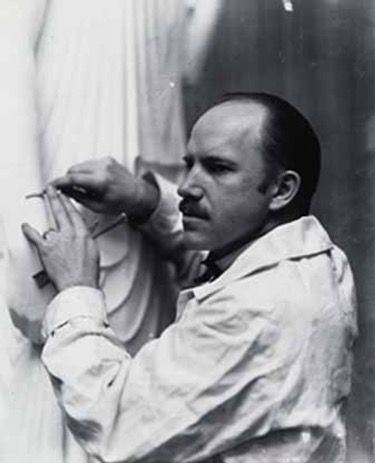
Peter A. Juley (1862-1937)
Paul Manship, n.d.
Smithsonian American Art Museum
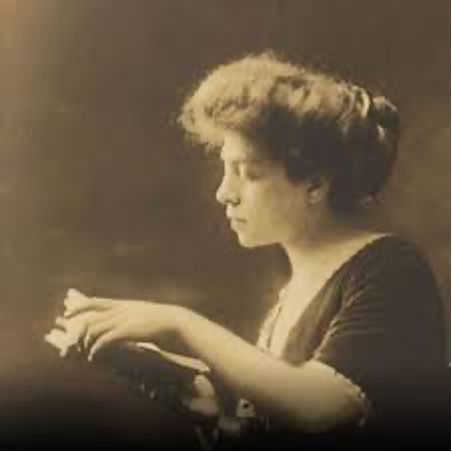
Adele Kibre
Frank Fairbanks was part of the expatriate arts community in Rome – Paul Manship was a close friend – and Adele Kibre, a medieval scholar (and later spy for the OSS) who was studying manuscripts from the Vatican collection, lived with the family for a while. She would bring home pictures of illuminated manuscripts, and David found himself fascinated by the intricate detail of the art and calligraphy. He began studying design and calligraphy.
After the death of his father, and with war clouds forming in Europe, he returned to New York, where he studied at Juilliard, taught ballroom dancing, and added a practical side to his design skills by taking a course in draftsmanship, and working during the war in a defense plant, where his duties included mapmaking.
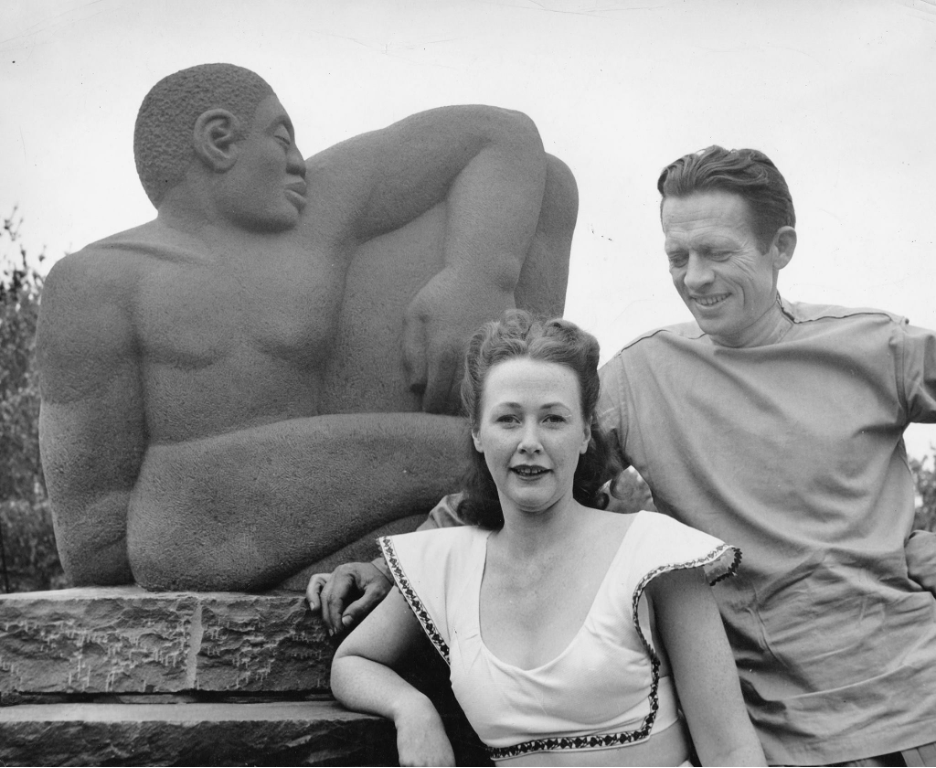
Wendell Jones (1899-1956)
Harvey and Barbara Fite at Opus 40, c. 1948
Opus 40
His sister Barbara had married a Foreign Service officer, J. Bartlett Richards, and moved to Washington, DC. After the United States entered the war, Richards was posted to China. By then their marriage was over, so Barbara and her two sons also moved to New York. Shortly thereafter, she moved upstate to Woodstock, for a reason that would surely not be a consideration today: she heard it was a cheap place to live. In Woodstock, she met Harvey Fite. They fell in love, but their romance was interrupted by a chilling diagnosis: tuberculosis.

She spent the next year in the Ulster County Tuberculosis Hospital on Golden Hill in Kingston, and David’s introduction to the area came from visiting her there.

Early Quarry with Sculpture,
Site of Opus 40, 1940s

Harvey Fite’s Opus 40
in Saugerties, New York, 2000s
Barbara and Harvey Fite were married in 1944, and she went to live permanently in the house in High Woods beside the huge stone quarry that Fite was beginning to transform into a sculptural landscape. At her urging, David moved to Woodstock after the war. He quickly found work in the Glasco Turnpike studio of well-known technical illustrator George Berk.

Richard E. Thibaut “Commissioned for Church Book,” Kingson Daily Freeman,
April 2, 1952, p. 11

Robert Hem, Poster of Winsor McCay, c. 1911
At the same time, he was able to bring together the full range of his interests – draftsmanship, the formal beauty of calligraphy, and a third interest, always dear to his heart – whimsy. He loved the cartoons and comics of Winsor McCay, George Herriman, Crockett Johnson, Fontaine Fox.

John Striebel, Dixie Dugan #1, July 1942
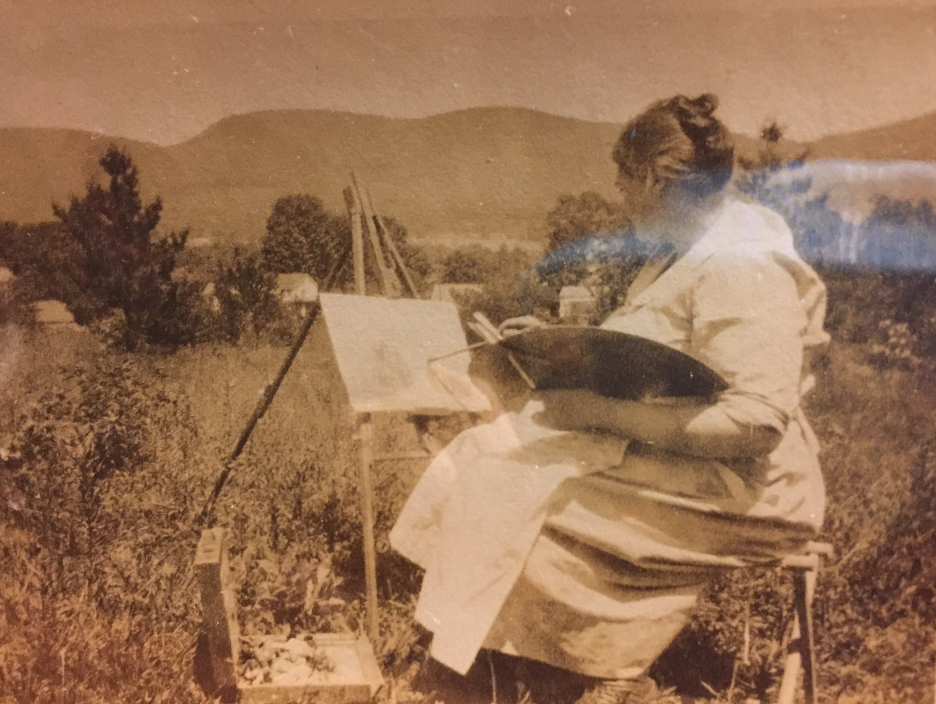
Unknown Photographer
Wilna Hervey, Art Students League, 1918
Woodstock Artists Association Archives
David’s natural warmth – and his talent for playing the piano – soon meant that he knew everyone in Woodstock – farmers, tradesmen, artists – including cartoonist John Striebel, creator of the popular comic strip Dixie Dugan, and Wilna Hervey, who had brought Fontaine Fox’s character Powerful Katinka to life in the silent movie shorts based on his Toonerville Trolley.
Woodstock and its surrounding areas were still sparsely populated in the 1940s, and new residents – or older residents who entertained weekend guests from the city – often needed to let people know how to find them, especially since back in the 1940s there were no highways--it was all back roads, and many of them not marked well. David’s maps for his friends, executed with exacting accuracy, wit, and artistic flourish, became popular.

David Fairbanks. Map for Dining Room, Ulster County Tuberculosis Hospital, Kingston, 1948
(Reproduced in “Old City Map at Hospital,” Kingston Daily Freeman, June 23, 1948, p. 1. )

“David Fairbanks, Woodstock Painter, Completes Motive,”
Ulster County Townsman. 1948
In 1948, Barbara suffered a recurrence, was readmitted to the Ulster County Tuberculosis Hospital. It was then that David, while visiting her, was commissioned to paint a mural in the hospital’s dining room – an 8’ x 9’ painting of Kingston’s Old Stockade, as it was in 1658, long before the Revolutionary War and the burning of Kingston in 1777. The mural had all the hallmarks of Fairbanks’s style – the precision learned in his defense plant work, and the calligraphy he loved in the labeling of points of interest. Another love, that of heraldry, also found a place in the mural, with his rendition of the coat of arms of the Reformed Dutch Church in America. The mural was completed in mid-May of 1948, and was historically accurate and involved much research. It shows the site of the old Academy, the First Dutch Church, Senate House, Dewaat Tavern, and other buildings that stood prior to 1777. The hospital was leveled around 2000.
And yet another love bloomed in the Ulster County Tuberculosis Hospital. Someone asked him to look in on a young woman who was a patient there. Seventeen years old, she had been hospitalized since she was thirteen, and she didn’t have more than a few months to live. David, with his songs and jokes and cheery disposition, might be able to brighten her days a bit. David visited the young woman, and fell in love with her. His friends tried to warn him against it – there’s no future. She’s going to die. No, he insisted, “My love will save her.”
And it did. She walked out of the hospital. They were married in 1953, and she lived another seven and a half years.
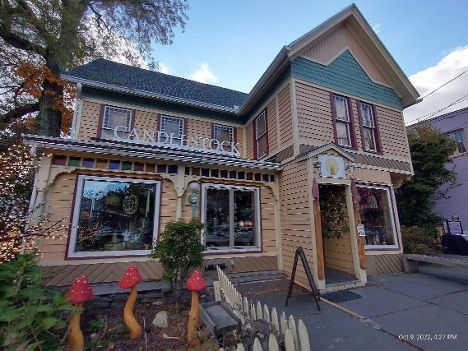
Candlestock, 16 Mill Hill Road,
Woodstock, New York

Advertisement for Exhibition of Caricatures by David Fairbanks at Town House,
Kingston Daily Freeman,
August 12, 1947, p. 14
In 1950, his romantic imagination and a certain impracticality of nature led him to rent a storefront in the center of the village, where either Candlestock or Pegasus is now. He lived in a small apartment over the store. The name of his new headquarters, and his new business, was The Scriptory. An article in the Kingston Daily Freeman of April 2nd, 1952 described it well:
“Visitors to David Fairbanks’ Scriptory, located on the village green, are immediately impressed with the unbelievably delicate quality of his work, which nevertheless contains the strength and aura of antiquity. A prayer, for instance, in ancient script will be surrounded by a beautiful border traced in gold and black, heightened by jewel-like colors, and may even contain a perfect miniature painting.
Since the opening of the Scriptory in 1950, Fairbanks has not only done manuscript illuminations, but, extending his interest to the art of heraldry, has designed coats of arms for bookplates, letterheads and other purposes. His maps have already become famous in the area, as well as his handsome monograms, bookplates, letterheads, and scrolls.
Recently, he completed work on his new shop display windows. Masked in rich Gothic red fabric, each window contains a small shadow box lined with a black material enhanced with an all-over fleur-de-lis pattern. They will serve as backgrounds for the framed manuscripts on view.
When Fairbanks completes the remodeling of the interior of The Scriptory, visitors will
be able to step through the door of the tiny shop and, with the artist, go back a few centuries while watching him at work on an ancient and revered art.”

David Fairbanks
Map of Woodstock, c. 1950
Private Collection

Upper Right Quarter of
Fairbanks Map of Woodstock
(All Details from Map in
Collection of Matthew Leaycraft)


Upper Left Quarter of Fairbanks Map of Woodstock


Bottom Left Quarter of Fairbanks
Map of Woodstock
It was during this time that he completed his 28” x 36” map of Woodstock, labeled in an inset as a “cartographical where’s who.” The map was commissioned by the Woodstock Business Association, and approved by the Woodstock Town Board in December 1950. The Kingston Daily Freeman announced in its issue of December 15th, 1950 that the "official map designed by David Fairbanks was displayed at the [association's recent] meeting and later placed in the Woodstock Post Office where it is now on view." The map combined all the facets of Fairbanks’s style: tradition, whimsy, warmth, and precision. It’s an accurate cartographic depiction of Woodstock at mid-century, personalized with the names of residents along with their houses.


Details of David Fairbanks Map of Woodtock, Collection of Matthew Leaycraft
The map includes little cartoon figures illustrating various points of the map—elfin creatures sheltering under a huge umbrella for Shady, a yodeling elf next to the Alpine Inn at the corner of Maverick Road, an elf in a polka-dotted bathing suit by the Big Deep, and, most prominently, a guffawing horse for the Maverick.

Detail of Inset at Lower Right, David Fairbanks Map of Woodstock.
Collection of Matthew Leaycraft
Another inset contains a detail of the village green. The boxes surrounding the map, each one naming a different facet of Woodstock life – art, business, recreation, communality – are in a unique Fairbanks alphabet that manages to combine the playful modernity of Disney with the reverent dignity of a medieval monkish scroll. The original of the map is now in a private collection (see above), and a published copy is located in the collection of Matthew Leaycraft of Woodstock (details that follow).
In 1953 David Fairbanks and Ruth Schermerhorn, the girl whose life he had saved with love, were married. Ruth was an evangelical Christian, a member of the Church of the Nazarene. David joined the church, and though Ruth died in 1960, he remained a devout evangelical Christian for the rest of his life.
This marked the end of David Fairbanks’s Woodstock history. He and Ruth moved to Ellenville, where he worked as a draftsman, a profession he would continue until his retirement. After her death, he moved to Virginia, where he met and married Clara Delilah (Penny) Shurter Gruner, and became the father to her daughter Patti.
He continued to do calligraphic and illuminated work, for which he was certified as a Master Penman by the International Association of Master Penmen, Engineers, and Teachers of Handwriting. An obituary written by a member of the Fountain Pen Network upon his death in 2004 describes his technique: "Although he was proficient at a number of broad pen alphabet styles, he enjoyed the discipline of engrossing most of all. Studying from the Zanerian Manual of Alphabets and Engrossing and the works of famed engrossers Alberto Sangorski and Arthur Szyk, David developed a style characterized by traditional composition, extreme detail in decoration, and dramatic use of color. His work exhibited a masterful sprinkling of filigree throughout border treatments, and the liberal use of gold to accent prominent features in the design."
Later in his life, David’s worldview narrowed in many ways. He developed some strong and unfortunate prejudices. Patti, his daughter, herself a devout churchgoing woman and conservative in many ways, stood up to him about his prejudices, but
she loved him deeply for his kindness.
I do not believe he was ever knowingly hurtful to anyone. And he saved another human being’s life with love, and who
among us can say that?

Charis Fairbanks
(wife of Frank Perley Fairbanks),
Tad Richards, David Fairbanks, c. 1941
He stayed in touch with me over the years. He would call often, because he could talk
to me about things none of his southern church folk knew anything about – cultural touchstones from his younger days. I came to know he would start off with a joke about the dumb blonde or the two colored gentleman, and I would let it pass, because – maybe I learned it from him -- I could never say anything hurtful to him, either, Then it was the Toonerville Trolley, Powerful Katinka, Harold Lloyd, the Keystone Cops, Moon Mullins, Pogo, George Formby.
And I believe he never stopped loving Woodstock, the Woodstock of his youth, the love that went into drawing that wonderful map. He would reminisce about Deanie’s, about Joe Forno. One time I took him to a play at the Town Hall by Performing Arts of Woodstock – a musical. He loved that – it felt like the Woodstock he remembered. He left the building singing the songs. And he still knew people. I drove him to a little side street – still in the Village – that I had never been on before, to look up an old lady who I guess had lived in that little house forever. I didn’t recognize her name. Who knows how long it had been since she had seen him, but she was delighted. Of course she was. Who could not love David?
Two more memories. Visiting Ruth’s grave, in Kingston. He stood there for a long moment, and then said, in a voice so deeply from the heart that it sent a tremor up my spine, “Next to finding my Saviour, she’s the best thing that ever happened to me.”

David Fairbanks, c. 1930s
Photograph courtesy of Patti Cox
He died in 2004. He visited me one last time, maybe a year earlier. When he died, he said, he planned to be buried next to Patti’s mother. I didn’t ask why, although I certainly wondered why not Ruth? But he told me. “It won’t matter to her, or to Ruth, or to me – we’ll all be dead. But it will matter to Patti.” He was buried next to Penny. But Patti arranged to have his name and dates carved on Ruth’s headstone.

This was a useful read for California vehicle owners who care about maintaining their cars. A dependable car protection coating can help shield exterior surfaces from everyday exposure while supporting a neat and well-maintained appearance.
Mình có lần lướt đọc mấy trao đổi trên mạng شيخ روحاني thì thấy nhắc nên cũng tò mò mở ra xem thử cho biết. Mình không tìm hiểu sâu جلب الحبيب chỉ xem qua trong thời gian ngắn để quan sát bố cục جلب الحبيب cách sắp xếp شيخ روحاني các mục và trình bày nội شيخ روحاني dung tổng thể. Cảm giác là các phần được trình bày khá gọn, các Berlinintim mục rõ ràng nên đọc lướt cũng không bị rối Berlinintim với mình như شيخ روحاني vậy là đủ để nắm tin cơ bản rồi. جلب الحبيب
👍
I found this article very informative because it explains how proper maintenance extends the life of decorative concrete. Professional stamped concrete repair helps restore damaged surfaces, improve safety, and preserve the attractive appearance of outdoor spaces for years.
I appreciate the clear explanation throughout the article. Helo says makes exploring local services much easier.
Great information shared in this article. Regular tree care makes a noticeable difference in both property safety and appearance. Choosing a professional tree trimming provider helps maintain healthy trees while reducing the risk of damaged branches during severe weather.