Liberating Women in Woodstock

By Adrianna Ashcraft, Gettysburg College class of 2026
“MAKING HER MARK: 50 WOMEN ARTISTS OF THE HISTORIC WOODSTOCK ART COLONY” WAS ON VIEW LAST SUMMER AT THE HISTORICAL SOCIETY OF WOODSTOCK, AND WAS DRAWN ENTIELY FROM THE FINE ART COLLECTION OF THE ORGANIZATION. ON JANUARY 28TH, 2026 THE EXHIBITION OPENED AT THE SCHMUCKER ART GALLERY AT GETTYSBURG COLLEGE
IN GETTYSBURG, PENNSYLVNIA, WHERE IT RUNS TILL APRIL 11TH. THE FOLLOWING POST
IS A CONTRIBUTION BY ADRIANNA ASHCRAFT, AN UNDERGRADUATE STUDENT AT GETTYSBURG COLLEGE.

Jane Jones (1907-2001)
Self-Portrait, 1960
ALL ACCOMPANYING IMAGES - COLLECTION OF
HISTORICAL SOCIETY OF WOODSTOCK
In the era of artistic rejuvenation, inspiration, and radicalization characterized by the Woodstock Art Colony, women are seldom included in the narrative of success. The legacy of Woodstock is dominated by the prominent male artists and founders. Bruce Weber’s exhibition, “Making Her Mark: 50 Women Artists of the Historic Woodstock Art Colony,” outlines the lives of fifty women who defined the artistic landscape at the art colony. His collection seeks to redefine Woodstock’s cultural, social, and artistic narrative away from the patriarchal influences that dominated the art landscape at the time. Weber provides the stories of the women and their range of artistic expressions. These women were educated, innovative, and used Woodstock as a sanctuary for existing outside of typical society.

FROM LEFT: WORKS BY JANE JONES, DORIS LEE, HELLEN GERARDIA,
AGNES HART. GRACE GREENWOOD,
ETHEL MAGAFAN, GWEN DAVIES

FROM LEFT:
JOSEPHINE BARNARD, MARY D. SMITH, ELIZABETH BUSH WOICESKE, ELEANOR LOCKSPEISER, LUCILLE BLANCH, DOROTHY GREENWOOD IVES,
SALLY MICHEL

FROM LEFT: MARION GREENWOOD, CAROLINE SPEARE ROHLAND,
BERYL GOSS, DOROTHY VARIAN,
ILONKA KARASZ, BARBARA NEUSTADT
Woodstock was created with the intention to be a free and inspiring space for artists to gather and work together in “creative harmony.”(1) Art colonies were associated with free thinking, and a “bohemian” lifestyle as participants were generally entrenched in the humanities and open mindedness. Woodstock was no exception, and it continued to harbor a space for radical perspectives and creativity throughout the duration of the twentieth century. The colony was established in 1902 by Ralph Radlciiffe Whitehead, Jane Byrd McCall, Hervey White, and Bolton Brown, and over time welcomed all media and genres, from realist to surrealist.(2) Likely because of its proximity to New York City, Woodstock became a welcoming environment for artists from diverse backgrounds and experiences.

FROM LEFT: JO CANTINE, MARGARET WETTERAU, LOUISE BROKENSHAW

VERTICAL ROW -LEFT:
MARION BULLARD, MARA ANGELOCH, AGNES BASKIN BIERHALS
VERTICAL ROW - MIDDLE:
PAMELA RAVENAL, NANCY SUMMERS
VERTICAL ROW-RIGHT:
ROSELLA HARTMAN, MARTHA LEVY
Many of the women in Woodstock received artistic education in urban art schools in places like New York City before moving to the countryside for inspiration and collaboration with other artists. This was a common practice for artists who were engaged in art colonies – for example, the Art Students League in New York was an essential institution for many of the artists in Woodstock, and women were no exception. The women featured in this exhibition all received formal art education from a myriad of backgrounds. In addition to the Art Students League, many of these women were members of Whitney Studio Club and art groups local to Woodstock like the Sawkill Group and the Kaaterskill Group. For example, Norma Morgan studied at the Whitney School of Art in New Haven, Connecticut before starting her career in New York and Woodstock. She later studied at the Art Students League when she received a more in-depth education in art.(3)
In addition to formal education, travel was an essential part of an artist’s training. Women in Woodstock were not bound to their households as the conventional roles of women at the time would dictate, rather, they were traveling to gain more inspiration and perspective. Notably, Marion and Grace Greenwood traveled to Mexico for inspiration, which helped shape their art. Morgan traveled to England and Scotland, where she was inspired to create landscape engravings and experiment with brightness and contrast.(4) Artistic education was key to women’s equality in the art sphere because it gave them an equal opportunity as male artists in the field. As Woodstock provided a space for women to be involved in and apply their skills, they were empowered to pursue experiences that enhanced their art, like education and travel.

FROM LEFT:
ZULMA STEELE, CAROLINE HABERLIN, JEAN WOLSEN, EUGENIE MCEVOY
In Woodstock’s liberating environment for creative innovation, women were engaging in new artistic expressions. The twentieth century was a period of shifting to increasingly abstract art forms, typically dominated by men. As has been noted by historians, “Even though women participated in every important art movement of their times, they were rarely present in surveys of American Art.”(5) Artists like Grace Greenwood and Gwen Davies were contributing to abstraction despite the field being predominantly men. Grace Greenwood was also inspired by French and Italian frescos and devoted the early part of her career to producing murals both in Mexico and America.(6) Furthermore, Woodstock was a space for women to disengage themselves from urban art spheres and the patriarchal institutions within. Throughout the twentieth into the twenty-first century, women were often excluded from museum or gallery expositions.(7) While they were excluded from large institutions, the women artists of Woodstock had a platform to work with others and to display their pieces free from misogynistic restrictions. Weber’s exhibition challenges that history of marginalization by uplifting the works that women created at Woodstock.

FROM LEFT:
MADELINE SHIFF WILTZ,
NAN MASON, JULIA LEAYCRAFT,
FLORENCE BALLIN CRAMER,
REEVES BRACE, ALTHEA O'DELL
While many of the women at Woodstock were married to men, there were some women who had nontraditional lifestyles while cultivating an artistic career free from stigmatization. Wilna Hervey and Nan Mason were in a same-sex partnership and were accepted into Woodstock’s community whereas outside the colony, their romance would have been taboo. While families were encouraged by Hervey White in the Maverick Art Colony to live together to prevent loneliness, family lives were altered by the unconventional lifestyle at Woodstock. Some artists, like Georgina Klitgaard, were devoted equally to both their children and their art, which created a balance between family and career that many women could not experience in the early twentieth century.(8) Women were not only engaging in their families and their careers, but also the community of Woodstock. Eugenie McEvoy recalled the living conditions at Woodstock, specifically the physical responsibilities that she had. During the harsh winters, McEvoy and other women would assist in hauling firewood to homes, extending their roles outside of the domestic sphere.(9) Woodstock’s community was much more fluid than the rest of the United States at the time so that women could balance different tasks or identities outside of the
status quo.

FROM LEFT:
NORMA MORGAN,
FLORENCE TUTTLE HUBBARD,
HESTER MILLER
Norma Morgan began working in Woodstock in 1969, where she was one of the few Black women artist's working in the village. Her success and experiences in New York City defied norms for her race and gender in America at the time. Morgan was educated at art schools in Connecticut and New York City, like the Whitney School of Art, the Art Students League, Atelier 17, and the school of Hans Hoiffman In addition to formal education, she was able to travel throughout England and Scotland through the support of fellowships, and developed a range of skills comparable to her artist peers.(10) Her artistic output ranged from paintings to prints, and her engravings became the best known of her works. She led a successful career in New York City , while returning periodically to the colony. Woodstock was an inclusive and progressive space that gave Morgan an additional community to pursue her career in art without inhibition.
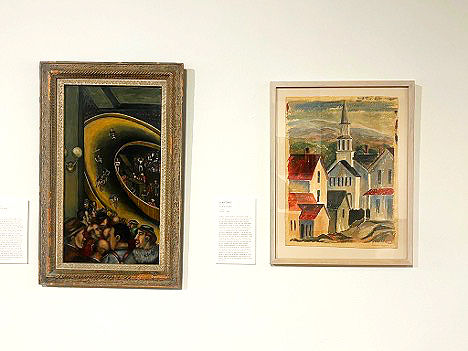
FROM LEFT:
MARY EARLEY, GEORGINA KLITGAARD

FROM LEFT:
EVA WATSON-SCHUTZE,
ALINE FRUHAUF, PEGGY BACON,
EUGENIE GERSHOY, WILNA HERVEY
Woodstock curated an environment that allowed female artists to pursue a lifestyle that was out-of-the-ordinary to their counterparts during the twentieth century. The “bohemian” and progressive ideals on which the colony was founded contributed to the liberating space for women to create art as they were often pushed from larger museums or galleries that favored the works of white men. Developing a more holistic approach in examining the careers of the contributing artists of Woodstock better contextualizes the artistic and social movements taking place there and the minority voices behind them.
(1) Steve Shipp, American Art Colonies, 1850-1930: A Historical Guide to America’s Original Art Colonies and Their Artists (Greenwood Press, 1996), x.
(2) MorganAnderson ArtSolutions. “The Historic Woodstock Art Colony – The Arthur A. Anderson Collection.” YouTube Video, June 10, 2024. https://youtu.be/yKzRYZTmf-E?si=juhDtbInvMS4hmfJ.
(3) Bruce Weber, “Norma Morgan: In the Lands of the Moors & Catskills,” Woodstock Art Colony, October 10, 2020. https://www.learningwoodstockartcolony.com/post/norma-morgan-in-the-lands-of-the-moors-and-catskills.
(4) Rowan Dodrick, “Woodstock Artist Sisters: Marion Greenwood & Grace Greenwood.” Woodstock Art Colony, May 2, 2025. https://www.learningwoodstockartcolony.com/post/woodstock-artist-sisters-marion-greenwood-grace-greenwood.
(5) Heather Anderson, “Making Women Artists Visible.” Art Education 45, no. 2 (1992): 15.
(6) Dordick, “Woodstock Artist Sisters.”
(7) Jill Fields, “Frontiers in Feminist Art History,” Frontiers: A Journal of Women Studies 33, no. 2 (2012): 2.
(8) Bruce Weber, “Making Her Mark: 50 Women Artists of the Historic Woodstock Art Colony,” (Historical Society of Woodstock, 2025), 2-3.
(9) Woodstock: In Search of Utopia.” YouTube Video, September 6, 2025. https://www.youtube.com/watch?v=Akn3ZqBJiUU.
(10) Weber, “Norma Morgan.”
s

Comments